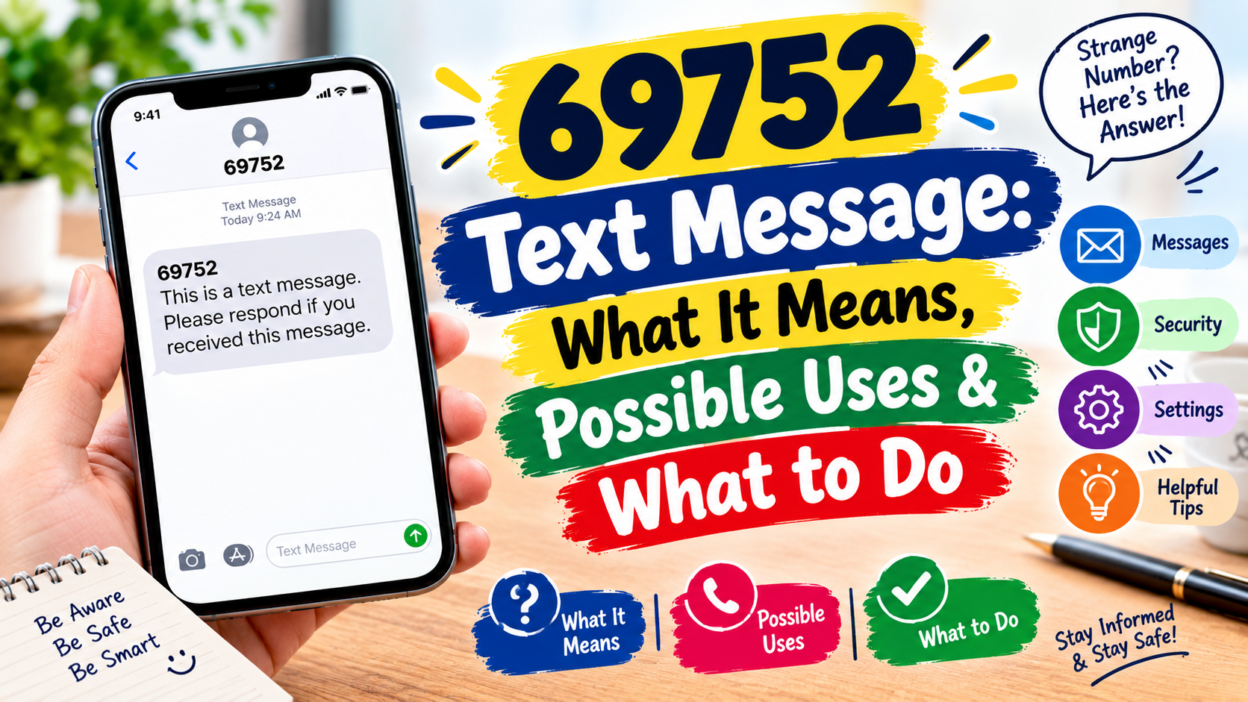
If you received a 69752 text message, you may be wondering who sent it, why it appeared on your phone, and whether you need to respond. A five-digit number can look like an ordinary phone number, but it may function differently. In many cases, numbers in this format are used as SMS short codes for automated messages.
However, there is an important detail about 69752: I could not find a reliable public source that identifies 69752 as an officially documented U.S. SMS short code belonging to a particular company or service. Current searches produce unrelated records and do not establish a verified owner for this specific number. Therefore, it would be misleading to claim that 69752 definitely belongs to one particular company.
That distinction matters. A short code can send legitimate alerts, verification messages, marketing texts, or other automated notifications. At the same time, an unexpected message can require caution, especially if it asks for passwords, payment information, or personal details.
This guide explains what can safely be concluded about a 69752 text message, how to investigate it, and what you should do if you don’t recognize the sender.
📱 What Is a 69752 Text Message?
A 69752 text message refers to an SMS that appears to come from the five-digit sender number 69752.
Five-digit senders are commonly called SMS short codes. Businesses, organizations, and automated services can use short codes instead of conventional 10-digit phone numbers. They can send notifications such as verification codes, account alerts, reminders, and promotional messages.
For example, you might receive a message like:
“Your verification code is 483921. Do not share this code.”
Or you could receive an automated notification about an account or service you recently used.
The number itself does not reveal the exact purpose of a message. Instead, you need to examine the message content and the circumstances in which you received it.
Importantly, a search for 69752 does not currently provide reliable evidence tying that code to one specific well-known U.S. service. That means readers should avoid websites that confidently assign an unverified company name to the number.
🔎 Is 69752 an Official SMS Short Code?
The number has the format of an SMS short code, but its exact ownership needs verification.
SMS short codes generally consist of five or six digits and are used by organizations for automated messaging. A short-code directory can sometimes identify the owner, purpose, and opt-out instructions. However, an unlisted number should not automatically be treated as either legitimate or fraudulent.
One current short-code directory explains that an unknown code is unverified, rather than automatically being a scam.
That is a useful distinction for 69752.
Therefore, if you see this number on your phone, don’t rely on the digits alone. Look at the full message, the links included, and whether you recently requested a service or verification code.
💬 Why Might You Receive a 69752 Text?
There are several possible explanations for an unfamiliar short-code message.
1. A verification or security message
You may receive an automated code after attempting to sign in, create an account, reset a password, or verify a phone number.
For example:
“Your verification code is 274911.”
If you initiated the action yourself, the message may be related to that activity.
2. An account notification
Some services use SMS to notify customers about account activity, login attempts, changes, or other events.
Microsoft, for example, explains that it may send verification texts when someone signs in or uses a feature requiring identity verification.
The same general principle applies to many online services, although that does not establish that 69752 belongs to Microsoft.
3. A message sent after someone entered your number
Sometimes a person enters the wrong phone number while signing up for an account or requesting a verification code.
As a result, you could receive a message even though you never created the account involved.
4. A marketing or notification message
Organizations can use SMS short codes for promotional campaigns, reminders, and customer notifications.
If you previously subscribed to messages from a service, an unfamiliar short code may simply be its automated sender.
5. An unwanted or suspicious message
An unexpected SMS can also be an attempt to make you click a malicious link or reveal information.
For that reason, the content of the message matters more than the number by itself.
⚠️ Does a 69752 Text Mean Someone Is Hacking You?
Not necessarily.
Receiving a message from 69752 alone doesn’t prove that someone has accessed your account. There are several harmless explanations, including a mistyped phone number or an automated notification.
However, an unexpected verification code deserves attention.
Suppose you receive:
“Your login code is 582104.”
You didn’t try to log in.
In that situation, don’t give the code to anyone. Someone could have entered your phone number while attempting to access an account, or the message could have resulted from an ordinary mistake.
Microsoft similarly advises users to treat unsolicited verification codes carefully because they can result from someone attempting to access an account or simply entering the wrong contact information.
So, rather than panicking, check the relevant account directly.
🧾 How to Read a 69752 Message Safely
Before taking action, examine the entire SMS.
Look for these details:
What to checkWhy it mattersSender numberConfirms the displayed SMS senderMessage wordingMay reveal the service or purposeVerification codeCould indicate an account-security eventLinksCan lead to phishing pagesCompany nameHelps identify the claimed senderRecent activityShows whether you actually requested the messageRequests for informationMay indicate a security concern
Don’t judge the message only by its appearance.
A professional-looking message can still contain a dangerous link. Likewise, an unfamiliar short code isn’t automatically malicious.
🔗 What If the 69752 Text Contains a Link?
Be especially careful with links in unexpected SMS messages.
A common phishing technique is to create a message that appears to come from a familiar company. The text may claim that your account has been locked, a payment failed, or unusual activity was detected.
You may then be encouraged to click a link.
Instead, open the company’s official website or app yourself. Don’t use the link supplied in an unexpected message.
Microsoft recommends this approach when users aren’t sure whether a text claiming to be from Microsoft is genuine. Its support guidance specifically advises avoiding questionable links and accessing the account directly.
Therefore, if a 69752 message contains a link you weren’t expecting, verify the sender independently before clicking anything.
🛡️ What Should You Do If You Didn’t Request the Message?
If you received a 69752 text without requesting it, don’t immediately reply or click a link.
Follow these steps:
Step 1: Read the message carefully. Determine whether it mentions a company, account, order, login, or verification attempt.
Step 2: Think about recent activity. Did you just sign up somewhere? Did you request a password reset? Did you log in from a new device?
Step 3: Don’t share verification codes. A legitimate verification code should remain private.
Step 4: Avoid unexpected links. If the message asks you to sign in, visit the service through its official app or website instead.
Step 5: Check your account independently. Look for unfamiliar login activity, password changes, or other notifications.
Step 6: Report or block the message if appropriate. Your mobile carrier and messaging app may provide spam-reporting options.
This approach is safer than trying to identify the sender from the five-digit number alone.
🚫 Should You Reply to 69752?
Whether you should reply depends on the actual message.
Some legitimate SMS services use specific keywords such as STOP for unsubscribing or HELP for assistance. However, you shouldn’t automatically respond to an unknown sender simply because those words are common in SMS marketing.
If the message is unexpected, first establish who is behind it.
If the message clearly identifies a service you’ve used, check that company’s official instructions for managing SMS notifications.
If the message appears suspicious, don’t provide personal information or follow instructions that could expose your account.
🧠 Common Mistakes People Make With Unknown Short Codes
Unfamiliar SMS numbers often create confusion. A few mistakes are especially common.
Mistake 1: Assuming the number identifies the company
A five-digit number doesn’t provide enough information to establish the sender’s identity by itself.
Mistake 2: Treating every verification code as a hack
An unexpected code can have several explanations. It may indicate an attempted login, but it could also result from someone entering the wrong number.
Mistake 3: Clicking because the message looks official
Brand names, logos, and professional wording can make a fraudulent message appear trustworthy.
Mistake 4: Sharing the code with another person
If someone contacts you and asks for the code you just received, don’t provide it.
Mistake 5: Searching only for the number
Searching 69752 text message may produce unrelated pages. The message’s wording and context often provide more useful clues.
🌎 Why Search Results for 69752 Can Be Confusing
Number searches can be surprisingly unreliable.
The number 69752 appears in unrelated online records, including software issue numbers, reference numbers, and other databases. A search result containing 69752 doesn’t necessarily have anything to do with SMS messaging.
For example, one search result for 69752 refers to an old PHP software bug rather than a text-message service.
Another result contains 69752 as an unrelated reference number.
This is why search results should be evaluated carefully.
A webpage mentioning “69752” isn’t evidence that it owns or operates the SMS number. Ideally, sender information should be confirmed through the organization’s own documentation or another authoritative source.
📲 69752 vs. a Verification Code
It’s also important to distinguish the sender number from the code inside the message.
Imagine an SMS displays:
From: 69752
Message: “Your verification code is 821644.”
In this example, 69752 is the sender identifier, while 821644 is the verification code.
Those numbers serve completely different purposes.
A Microsoft support example makes the same distinction for its own SMS messages: the sending number and the security code are separate pieces of information.
Therefore, don’t assume that the five-digit sender is the security code you need to enter.
💼 Can a 69752 Message Be Related to Work or School?
Potentially, yes, depending on the organization and the message.
Companies and educational services may use automated SMS systems for:
- Login verification
- Appointment reminders
- Account notifications
- Password recovery
- Service updates
- Registration confirmations
For example, a student might receive an automated verification message after creating an account on an educational platform. Similarly, an employee could receive an authentication code when signing into a workplace system.
However, there is currently no reliable evidence establishing that 69752 specifically represents a particular school, employer, or educational platform.
Context remains essential.
👨👩👧 Why Someone Else Might Receive the Message
A phone number can sometimes be connected to an account by mistake.
Consider this situation:
Someone is creating an online account and accidentally types one incorrect digit in their phone number. The service sends its verification message to the number they entered.
You receive it.
That doesn’t necessarily mean your phone or account has been compromised.
Likewise, recycled phone numbers can sometimes create confusion when a number previously belonged to another person.
So, if a 69752 text appears unexpectedly, don’t assume the worst based solely on the fact that you received it.
🔐 What Information Should You Never Send Back?
Regardless of the sender, avoid sharing sensitive information through an unexpected SMS conversation.
This includes:
- Passwords
- One-time verification codes
- Banking PINs
- Credit-card details
- Social Security numbers
- Account recovery codes
- Full identity information
A legitimate company generally shouldn’t need you to disclose a private authentication code to an unsolicited caller or texter.
If you’re asked for sensitive information, stop and verify the request through the organization’s official website or app.
🧩 What If You Keep Receiving Messages From 69752?
Repeated messages deserve a closer look.
First, determine whether they all concern the same service. Look for repeated wording, links, account references, or verification instructions.
Next, check your accounts for unusual activity.
If the messages are clearly unwanted marketing, use the legitimate unsubscribe mechanism provided by the sender when you’re confident the message is genuine. Otherwise, use your carrier’s spam-reporting tools rather than engaging with a suspicious sender.
You can also block the sender through your phone’s messaging application, although blocking doesn’t necessarily address the underlying reason for the messages.
❓ Frequently Asked Questions About 69752 Text Message
Is 69752 a phone number?
Not in the usual sense. It has the format of a five-digit SMS short code rather than a conventional personal mobile number. However, its specific ownership isn’t established by the number alone.
Who owns 69752?
I couldn’t verify a reliable public source that identifies a current U.S. organization as the owner of 69752. Therefore, claims assigning it to a specific company should be treated cautiously.
Is 69752 a scam?
The number alone doesn’t establish that a message is a scam. Look at the content, links, requests, and context before deciding how to respond.
Why did I get a 69752 verification code?
Possible explanations include an account sign-in, registration attempt, password reset, or someone entering your phone number by mistake. If you didn’t request the code, don’t share it.
Should I click a link in a 69752 text?
If you weren’t expecting the message, avoid clicking the link. Instead, open the relevant service through its official app or website and check your account there.
Can I block 69752?
Your phone or carrier may allow you to block or report unwanted SMS messages. The exact process varies by device and carrier.
What should I do if someone asks for my 69752 verification code?
Don’t share it. If you recently attempted to sign in, enter the code only into the legitimate service you were using. Never give an authentication code to someone who contacts you unexpectedly.
Does receiving 69752 mean my account was hacked?
No. Receiving an unexpected text isn’t proof that an account was compromised. It can have several explanations, although you should check your account if the message concerns an unrequested login or security code.
📝 Final Takeaway
A 69752 text message appears to come from a five-digit SMS sender, but available public search evidence does not reliably identify one specific organization behind the number. That makes it important to avoid unsupported claims about its ownership or purpose. Instead, examine the message itself, consider whether you recently requested an account action, and avoid clicking unexpected links or sharing verification codes. When a message concerns an account you use, verify the activity directly through the company’s official app or website. This simple approach helps separate ordinary automated messages from situations that deserve closer attention.