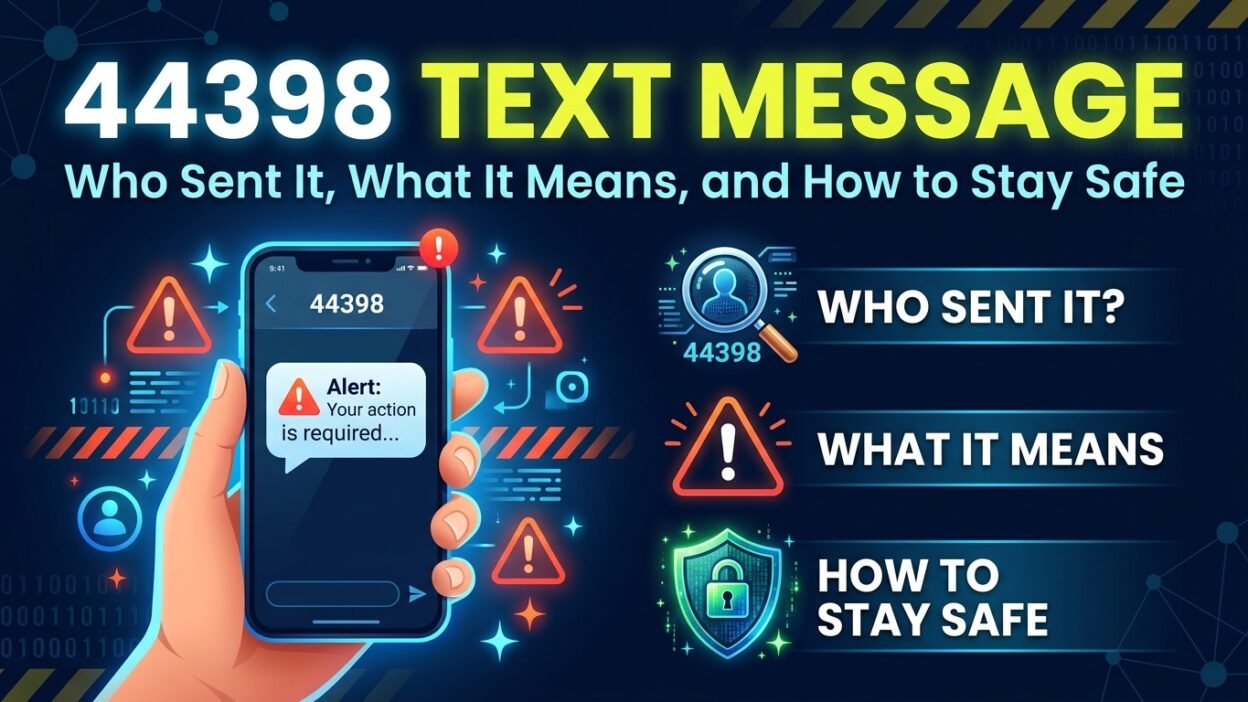
If you received a 44398 text message, you may be wondering who sent it, why it appeared on your phone, and whether you need to take action. This five-digit number is associated with automated SMS services, including verification messages. However, identifying the exact sender requires more than looking at the number alone.
Online lookup sources have associated 44398 with Firebase Alert, while other reports connect it with Hinge verification codes and account authentication. These reports provide useful clues, but they don’t establish who sent every message from this number.
In this guide, you’ll learn what the number may represent, why an unexpected verification code might arrive, how to check the message safely, and what to do if you don’t recognize it. We’ll also explain the difference between a legitimate authentication text and a possible scam.
The most important point is simple: don’t share a verification code or click an unexpected link until you’ve verified the situation. You can investigate the message without revealing private information or risking access to your accounts.
🔎 What Is the 44398 Text Message?
The number 44398 is a five-digit SMS short code associated with automated messaging services. Unlike an ordinary mobile number, a short code can be used to deliver notifications, verification codes, and other service-related messages.
One third-party directory lists 44398 under the campaign name Firebase Alert. Other online reports associate it with verification messages, including Hinge account authentication. These listings may reflect different uses or different periods of activity, so they shouldn’t be treated as definitive proof of the sender.
Here are the main possibilities to consider:
- Account verification: A service may send a one-time code to confirm access or verify a phone number.
- Authentication services: An application may use an underlying messaging provider to deliver a security code.
- A sign-in attempt: Someone may have entered your number while trying to register or access an account.
- An incorrect phone number: Another person may have accidentally entered your number during registration.
- An unexpected or suspicious message: A message may be unwanted, misleading, or designed to collect sensitive information.
The content of the SMS matters more than the five digits by themselves. For example, a message containing a short numeric code and naming a service has a different purpose from a message demanding payment through an unfamiliar link.
Nevertheless, even a convincing-looking verification message deserves attention if you didn’t request it.
📱 Why Did You Receive a Message From 44398?
There isn’t one confirmed explanation for every message from this short code. The circumstances surrounding its arrival can help you narrow down the possibilities.
You requested a verification code
If you were signing in to an app, creating an account, or confirming your phone number, the message might be part of that process.
Some online reports associate 44398 with Hinge verification messages, and other listings connect it with Firebase-related authentication. However, the sender and purpose should be confirmed from the message and the service’s official information.
Someone entered your number by mistake
Phone number errors happen during registration. Another person might accidentally submit your number instead of their own.
In this situation, you could receive a verification code without having requested one. The message alone doesn’t establish that someone accessed your account or intentionally targeted you.
Someone tried to sign in or register
An unexpected code can also indicate that somebody entered your phone number while attempting to access or create an account.
That doesn’t automatically mean the attempt succeeded. Verification codes commonly serve as an additional step intended to prevent unauthorized access.
If you didn’t initiate the request, don’t provide the code to anyone. If you already use the named service, open its official app directly and check for unfamiliar account activity.
An automated service sent a notification
Businesses and technology platforms use automated SMS systems to communicate with customers. Depending on the service, messages can include account alerts, registration confirmations, or other transactional notifications.
However, don’t assume that an unexpected message is legitimate simply because it comes from a short code. Check the sender’s identity before responding or following instructions.
🛡️ Is the 44398 Text Message Legitimate or a Scam?
A message from 44398 isn’t automatically a scam, but the number alone can’t guarantee that a message is genuine.
Third-party directories associate this code with legitimate messaging or authentication uses. At the same time, those listings don’t independently verify every message received by every phone number.
Use the following comparison to evaluate the message you received.
Message characteristic
What it may indicate
A verification code you just requested
A normal authentication process
A code you didn’t request
A mistake or an unexpected sign-in attempt
A request to share your code with another person
A serious security warning
An unfamiliar link asking for account details
A possible phishing attempt
A demand for immediate payment
A reason to investigate independently
A message naming a service you recognize
A useful clue, but not complete proof
Remember: a legitimate-looking number doesn’t make every message trustworthy. Scammers can imitate familiar brands and use convincing language to make people act quickly.
Instead of deciding based on the sender number alone, examine what the message asks you to do. A routine verification code is different from a message requesting your password, banking details, or payment.
If you’re uncertain, don’t respond immediately. Verify the claim through the service’s official app or website.
🔐 What Does a 44398 Verification Code Mean?
A verification code is a temporary number used to confirm that someone can receive messages at a particular phone number or complete a specific authentication step.
For example, you might request a code while creating an account, signing in, or recovering access. The service then sends a message containing a code that you enter into its official sign-in screen.
If your 44398 message contains a code, consider these possibilities:
- You recently requested a code from the service named in the message.
- Someone else entered your phone number accidentally.
- Someone attempted to register or sign in using your number.
- A delayed message arrived after you had already completed the process.
The code itself doesn’t tell you which explanation is correct.
What if you didn’t request the code?
First, leave the message alone. Don’t share the code with anyone, even if the person claims to be a customer support agent.
Next, identify the service named in the text. If you have an account with that service, open its official app or type its known website address into your browser. Check for unfamiliar sign-in activity and review your security settings if necessary.
If you don’t recognize the service, you generally don’t need to use the code. An unsolicited verification message doesn’t prove that an account was successfully created or accessed.
Furthermore, don’t assume that a code mentioning a particular app proves someone has an active account there. A registration attempt, an incorrect number, and an existing account can produce different situations.
🧭 How to Identify Who Sent the 44398 Text
Finding the sender requires a little investigation. Follow these steps before deciding whether the message is legitimate.
1. Read the entire message
Look for the company or application name, the reason for the notification, and any instructions.
A message stating that a code is for account verification gives you a useful starting point. However, the displayed name and wording should still be checked independently.
2. Check your recent activity
Think about whether you recently signed up for a service, requested a password reset, or attempted to log in.
If the timing matches an action you initiated, the message may be expected. If nothing matches, avoid using the code until you understand why it arrived.
3. Verify the service independently
Visit the company’s official website or open its established application. Search its help center or security documentation for information about verification texts.
Don’t use an unfamiliar link in the message to verify the sender. Instead, find the service through a trusted route.
4. Treat lookup directories as clues
Websites such as TextingWorld and Shortcodes.org provide information about short codes, while community reports can reveal how other users encountered them. However, their information may be incomplete or outdated.
For this reason, don’t rely on a single directory to establish the identity of the sender.
5. Contact the actual service if needed
If the message claims to concern an account you own, contact the company through its official support channel. Explain that you received an unexpected text and ask whether the service sent it.
Never give a support representative your one-time verification code merely to prove your identity.
⚠️ What Should You Do If You Never Requested a 44398 Text?
Receiving an unexpected message can be confusing, especially when it mentions an account or application you don’t remember using. Fortunately, you can take sensible precautions without assuming the worst.
Don’t share the code
Keep verification codes private. If someone contacts you and asks you to read out the code, don’t comply.
Avoid suspicious links
Don’t tap links or download files from an unexpected text. Access the service through its official website or app instead.
Check the relevant account
If you recognize the service, review recent activity and security notifications. Change your password if you find evidence of unauthorized access or believe your credentials were exposed.
Keep evidence of suspicious messages
Save a screenshot or retain the message if you need to report it. Avoid sharing screenshots publicly if they contain codes, phone numbers, or other private information.
If you only received a code and didn’t interact with the message, you may not need to do anything further. Monitor the relevant account if you have one, and take additional action only if you notice signs of suspicious activity.
However, if you receive repeated codes or unexpected password-reset alerts, investigate the relevant service rather than ignoring the pattern.
🚫 How to Stop Unwanted Messages From 44398
The right way to stop messages depends on whether you knowingly subscribed to the service and whether the message appears legitimate.
Some short-code programs support standard opt-out commands. One directory specifically lists STOP as an opt-out option for the Firebase Alert campaign associated with 44398. That listing isn’t proof that every message from the number belongs to the same program.
If the message clearly identifies a service you’ve used and provides legitimate opt-out instructions, you can follow those instructions to stop future messages.
If you don’t recognize the sender or suspect fraud, a safer approach is to avoid replying. Instead, block the sender if appropriate and report the message through your carrier’s supported process.
You can also take these steps:
- Use your phone’s messaging controls to block unwanted messages where supported.
- Report suspected spam through your mobile carrier.
- Check the named service’s official communication preferences if you have an account.
- Avoid sending personal information in response to unexpected texts.
Blocking a short code may prevent future messages from that sender on your device, but it won’t necessarily stop messages from other numbers or resolve an account security issue.
If the messages continue, contact your carrier or the company that operates the relevant service.
📲 Could 44398 Be Connected to Hinge or Firebase?
This is an important question because online sources don’t all describe the code in the same way.
A short-code directory lists 44398 under the name Firebase Alert. Another source identifies the code among those associated with Hinge verification, and a Google Fi community discussion describes a user receiving an unexpected verification text connected with Hinge.
These reports suggest possible authentication-related uses, but they don’t prove that every 44398 text comes from Hinge or Firebase.
Here’s how to interpret the possibilities:
Name
What it refers to
What you should check
Firebase
A Google platform that includes authentication technology
Whether the message identifies an app or service you use
Hinge
A dating application that has been associated with this short code in online reports
Whether you recently requested a Hinge verification code
Another service
A possible different use or an outdated directory association
The message details and the service’s official documentation
Firebase is a technology platform, not necessarily the consumer-facing application you interacted with. An application may use an authentication provider to deliver its verification codes.
Therefore, seeing a reference to Firebase doesn’t automatically mean you created a Firebase account. Similarly, receiving a Hinge-related code doesn’t prove that someone successfully created a profile or accessed an existing account.
If the message mentions a service you don’t recognize, don’t jump to conclusions. Verify the details independently and keep the code private.
🕵️ What If You Receive a 44398 Text Without Any Message?
Sometimes people notice a short code in a carrier log, message history, or account activity record without seeing the actual SMS on their phone.
A missing message can have several explanations, including a delivery problem, a device or carrier record that differs from the visible inbox, or a message that was filtered or deleted.
A Google Fi community discussion documents a user who noticed 44398 in a text log without finding the corresponding message on the phone. However, that report doesn’t establish one universal reason for missing messages.
Google Fi Wireless Community
If this happens to you, try the following:
- Check your messaging app’s spam, blocked, and archived folders.
- Compare the time shown in your carrier log with your phone’s message history.
- Ask your carrier whether it can clarify the record.
- Review the security activity of any account you suspect may be involved.
If you find no unusual account activity, a missing message alone isn’t sufficient evidence of a security breach.
On the other hand, if you also notice password-reset emails, unfamiliar sign-ins, or account changes you didn’t make, take those warning signs seriously. Secure the affected account through its official website or application.
🌐 Does the Meaning of 44398 Change by Country?
Yes, short-code use can vary by country, mobile network, and messaging program.
A five-digit number used in one market may not have the same purpose in another. Some countries also have different rules and arrangements for registering and operating short codes.
Consequently, a directory entry associated with a US messaging campaign may not fully explain a message received while traveling or using an international mobile service.
If you’re outside the United States, consider these factors:
- Your mobile network: The carrier may handle international messages differently.
- Roaming: A message may arrive while your phone uses another network.
- The service involved: An app may send authentication messages to users in several countries.
- The source of the information: A directory may describe a particular country’s use rather than every possible use worldwide.
The safest approach remains the same regardless of location: identify the service named in the message, verify it independently, and never share a verification code with another person.
💡 Common Mistakes to Avoid With 44398 Text Messages
People often make quick assumptions when an unfamiliar number appears on their phones. Avoiding these mistakes can help you protect your accounts and personal information.
Mistake 1: Assuming the number identifies the sender with certainty.
Short-code directories can be helpful, but listings may be incomplete or outdated. Confirm the message through the service’s official channels.
Mistake 2: Assuming an unexpected code proves someone hacked your account.
A code may result from a mistyped number or an unsuccessful sign-in attempt. Look for additional evidence before drawing conclusions.
Mistake 3: Sharing a code with someone who claims to be support staff.
A verification code can help another person complete an authentication step. Keep it private, even if the request sounds convincing.
Mistake 4: Clicking a link to check whether the message is real.
An unfamiliar link can lead to a fake login page. Open the service independently instead.
Mistake 5: Replying to every unexpected message.
Although legitimate programs may support opt-out commands, replying to an unverified sender isn’t always the best option. Check the sender and the instructions before responding.
Mistake 6: Ignoring other signs of account trouble.
A single unexpected code may be harmless. However, repeated authentication attempts alongside unfamiliar account activity deserve investigation.
Ultimately, the goal isn’t to panic whenever you receive an unfamiliar text. It’s to make decisions based on verifiable information rather than assumptions.
❓ Frequently Asked Questions About 44398 Text Messages
1. Who owns the 44398 text message short code?
Third-party directories associate 44398 with Firebase Alert, while other sources connect it with authentication messages and Hinge verification. These listings don’t conclusively establish the sender of every message. Check the message content and the named service’s official documentation before deciding who contacted you.
2. Is a 44398 verification code safe to use?
It can be legitimate if you requested it from a service you’re trying to access. Enter the code only on that service’s official sign-in or verification screen. If you didn’t request it, don’t share it or enter it into an unfamiliar website.
3. Why did I receive a 44398 text when I don’t use Hinge?
An incorrect phone number, an attempted registration, or another authentication-related event could explain the message. Online reports associate 44398 with Hinge, but an unexpected code doesn’t prove that you have a Hinge account or that someone successfully accessed one.
4. Should I reply STOP to 44398?
Replying STOP may work when the message belongs to a legitimate subscription program that supports opt-outs. A directory lists this command for the Firebase Alert campaign associated with the code. If you suspect a scam or can’t identify the sender, avoid replying until you’ve verified the program.
5. Can someone access my account using a 44398 verification code?
Receiving a code alone doesn’t mean someone accessed your account. However, if you give a valid code to another person, they may be able to complete an authentication step, depending on the service and its security protections. Never share one-time codes, and review your account if you notice suspicious activity.
6. What should I do if 44398 keeps texting me?
First, identify the service behind the messages. If the texts are legitimate but unwanted, follow the service’s verified opt-out instructions. Otherwise, block or report the messages through your phone or carrier. If they relate to an account you own, check its security settings.
7. Does receiving a 44398 text mean someone is using my phone number?
It may mean someone entered your number into a registration or sign-in process, but it doesn’t establish why. A typing mistake is another possibility. If the messages continue or you notice other suspicious activity, investigate the relevant account and contact the service through an official channel.
✅ Final Thoughts on the 44398 Text Message
A 44398 text message may be an automated verification message, but the number alone doesn’t establish who sent it or why it arrived. Online sources associate the code with Firebase Alert and authentication-related uses, including reports involving Hinge. Nevertheless, these associations should be treated as clues rather than definitive proof of the sender.
If you requested a verification code, use it only through the service’s official interface. If you didn’t request one, keep it private, avoid suspicious links, and check any relevant account for unfamiliar activity. You can also contact the service or your mobile carrier if the messages continue.
Above all, stay calm and verify the facts. An unexpected text doesn’t automatically mean your account has been compromised, and a familiar-looking short code doesn’t guarantee that every message is trustworthy. A few careful checks can help you decide what to do next while protecting your personal information.