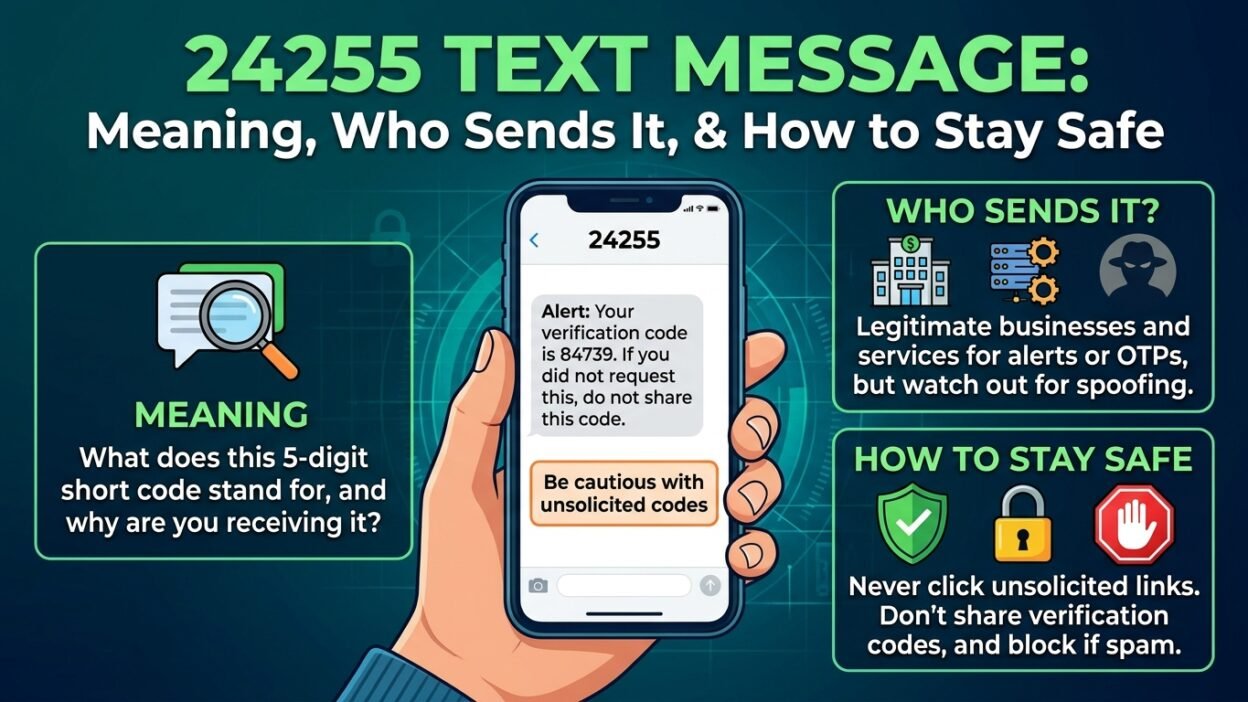
If you received a 24255 text message and aren’t sure who sent it, you’re not alone. An unfamiliar five-digit number can leave you wondering whether the message comes from a legitimate business, an automated notification service, or an unwanted sender.
The important thing is to identify the message before responding. Short numbers, often called SMS short codes, can support business notifications, verification messages, promotional campaigns, and other automated communications. However, a five-digit number alone doesn’t establish who sent a particular text.
This guide explains what to know about the 24255 text message, how to investigate its source, which warning signs to look for, and what to do if the message seems suspicious. It also covers verification methods, privacy concerns, and practical steps for handling unexpected texts.
A key distinction: Without reliable carrier or service-provider records linking 24255 to a specific organization, its sender and purpose remain unconfirmed. The safest approach is to examine the message’s contents and verify any claims independently.
🔎 What Is the 24255 Text Message?
The number 24255 is commonly listed in third-party SMS directories as a short code associated with Affirm payment and reminder alerts. These listings associate the code with account notifications and verification messages.
Affirm offers buy now, pay later services, allowing eligible customers to split certain purchases into payments. Therefore, if you recently used Affirm at an online store, received a payment reminder, or attempted to sign in, a message connected with that service may explain the notification.
However, directory listings aren’t the same as confirmation of an individual message. A code’s listed association doesn’t prove that every text displaying it is genuine, nor does it establish that you have an account.
Here are the key points to understand:
- Short code: 24255 is a five-digit number used for SMS communications.
- Reported association: Third-party directories identify it with Affirm payment and reminder alerts.
- Possible purpose: Messages may relate to verification, account activity, or payment notifications.
- Important limitation: Your exact message must be evaluated separately.
For additional context, you can review the Treat directory information as a starting point, then verify any account-related claims through the relevant company’s official website or app.
📱 Why Did You Receive a Text From 24255?
The reason depends on the message’s wording and your recent activity. In many cases, an unexpected notification has an ordinary explanation. Nevertheless, you shouldn’t assume that an unfamiliar message is legitimate simply because it mentions a recognizable company.
1. You requested a verification code
If you were signing in to an account or completing a purchase, the message might contain a one-time passcode.
For example, you might see a message stating that a verification code is ready to use. If you initiated the request yourself, enter the code only on the official app or website where you started the process.
On the other hand, if you didn’t request a code, don’t share it with anyone. Someone could have entered your number by mistake, or somebody might be attempting to access an account associated with it.
2. You made a purchase using a payment service
Some payment providers send notifications when customers complete purchases, arrange installments, or receive transaction updates.
Consequently, check whether you recently selected a buy now, pay later option at checkout. An older purchase or a payment-related event might also explain a notification you weren’t expecting.
If the message mentions a merchant or purchase you don’t recognize, inspect your account independently rather than clicking its links.
3. You received a payment reminder
A message may refer to a scheduled payment, an upcoming due date, or another account event.
However, scammers sometimes imitate payment reminders to encourage people to act quickly. Compare the amount, merchant, and due date with the information displayed in your official account.
Never make a payment solely because an unexpected text demands it.
4. Someone entered your phone number by mistake
A person registering for a service or completing checkout could accidentally enter the wrong phone number.
As a result, you might receive a legitimate verification code without having an account yourself. A single unexpected code doesn’t automatically mean your identity has been stolen.
Still, don’t forward the code or respond to anyone asking you to confirm it. If the messages continue, take the time to investigate.
5. The message could be fraudulent
Another possibility is an impersonation attempt. A fraudulent message might claim that your account is locked, your payment failed, or your identity needs immediate verification.
In that situation, the message’s content matters more than its appearance. Check the sender’s claims through a trusted channel before taking action.
🧾 What Different 24255 Messages Might Mean
The wording can help you determine what to investigate next. The following examples are illustrative, not verified transcripts from the sender.
Message type
Possible explanation
Recommended action
Verification code
A login or checkout attempt
Use it only if you initiated the request
Payment reminder
An upcoming installment or account obligation
Check your official account
Purchase notification
A transaction or checkout event
Confirm the merchant and amount
Account alert
A possible change or activity notification
Sign in independently to investigate
Promotional offer
A marketing message
Verify the sender before engaging
Urgent account warning
A legitimate alert or an impersonation attempt
Avoid links and verify independently
This comparison is a guide, not proof of the sender’s identity. If the text doesn’t mention a recognizable company or activity, don’t guess its purpose based on the number alone.
🛡️ Is 24255 Legitimate or a Scam?
The short code has a reported association with Affirm, but that alone doesn’t establish that your specific message is safe. Third-party listings and examples of messages associated with the code support the connection, although an independent check remains important.
A useful way to assess the situation is to separate the sender identification question from the message’s actual request.
A notification about an activity you recognize may be routine. Conversely, a message that asks you to reveal a password, share a security code, or visit an unfamiliar payment page deserves caution.
Watch for these warning signs:
- Unexpected urgency: The message threatens immediate account closure or financial loss unless you act.
- Sensitive information requests: It asks for your password, PIN, or complete payment details.
- Unfamiliar links: The web address doesn’t match the company’s genuine domain.
- Unrecognized transactions: It mentions a purchase or payment you never made.
- Pressure from another person: Someone contacts you asking for a code that arrived on your phone.
Importantly, poor grammar isn’t required for a scam, and professional-looking language doesn’t prove authenticity. Even a message that appears in an existing conversation should be verified when it asks you to take a sensitive action.
For further guidance on handling unwanted messages, visit the US Federal Trade Commission’s.
🔐 What Should You Do After Receiving a 24255 Text?
You don’t need to panic when an unfamiliar number appears on your phone. Instead, follow a few practical steps to understand the message without exposing your personal information.
Step 1: Read the entire message
Identify the company name, stated reason for contacting you, and any requested action. Don’t rely on the five-digit number alone.
Step 2: Verify the information independently
If the text mentions Affirm, open its official app or type its website address into your browser yourself. Check your account activity without using the message’s link.
Step 3: Protect your verification codes
Never give an authentication code to a caller, friend, or supposed support agent. If you didn’t request the code, leave it unused.
Step 4: Review your account activity
Check for unfamiliar purchases, payment arrangements, login activity, or changes to your account details. Contact the company through a verified support channel if something looks wrong.
Step 5: Block or report suspicious messages
If the message appears fraudulent, use your phone’s reporting tools and contact your mobile carrier if necessary. Don’t reply to suspicious senders or follow their instructions.
These precautions help whether the message is a routine notification, an accidental verification request, or a possible phishing attempt.
💳 What If You Don’t Have an Affirm Account?
Receiving a message associated with a financial service when you’ve never used it can be confusing. Fortunately, there are several possible explanations, and not all indicate fraud.
Someone may have entered your number incorrectly. During registration or checkout, a customer could accidentally provide another person’s phone number. In that case, the verification message may reach you instead.
Your number may have belonged to someone else. Phone numbers sometimes get reassigned. If a previous owner used a financial service, automated messages might continue until the account details are updated.
Someone may be attempting to use your information. This possibility deserves attention if you receive repeated verification codes, discover unfamiliar financial activity, or notice account notifications you cannot explain.
Here’s how to respond:
- Don’t share any codes or personal information.
- Avoid clicking links in unexpected messages.
- Check whether you have any legitimate connection to the company.
- Contact its official support team if the messages continue.
- If you discover an account or transaction in your name that you didn’t authorize, report it promptly.
If you receive only one unexpected verification code, you don’t necessarily need to change every password you own. However, if you suspect an actual account compromise, secure the relevant account and investigate further.
🚨 What If You Clicked a Link in a 24255 Text?
The appropriate response depends on what happened after you opened the link. Clicking a link doesn’t automatically mean your account has been compromised, but you should assess the situation carefully.
What happened
What to do next
You opened the link but entered nothing
Close the page and avoid downloading anything from it
You entered a password
Change it through the genuine website or app; update other accounts if you reused it
You shared a verification code
Secure the relevant account immediately and contact official support
You entered card or bank details
Contact your bank or card issuer using its verified contact information
You downloaded a suspicious file
Don’t open it; remove it if safe and run a trusted security scan
You noticed unauthorized transactions
Contact the financial institution immediately and dispute unauthorized activity
Additionally, enable multifactor authentication where available and review recent account sessions. If you reused a compromised password elsewhere, replace it with a unique one.
If you provided identity information, consider the relevant identity-protection steps for your country. In the United States, the provides guidance for people who believe someone has misused their information.
📵 How Can You Stop Unwanted Messages From 24255?
If the messages are unwanted marketing notifications, you may be able to unsubscribe. However, first consider whether the message is legitimate and whether you recognize the service.
For a legitimate SMS program, replying STOP may unsubscribe you. Third-party listings for 24255 also describe STOP as an opt-out instruction.
Who Texted Me From 24255?
+1
Follow these precautions:
- Only use an opt-out reply when you have reasonable grounds to trust the messaging program.
- If the message appears fraudulent, don’t reply or interact with its links.
- Block the sender through your phone’s messaging settings if necessary.
- Contact the identified company directly if legitimate messages continue after you unsubscribe.
- Report suspected spam through your carrier’s supported reporting process.
In the United States, many mobile carriers accept spam reports forwarded to 7726 (SPAM). Availability and reporting procedures can vary by carrier and country.
If you live outside the United States, use your local carrier’s reporting instructions rather than assuming that every US short-code procedure applies to your network.
🌐 Does the Meaning of 24255 Change by Country or Carrier?
Yes, short-code identification can depend on the country and mobile network. A number associated with a business in one market shouldn’t automatically be assumed to have the same use everywhere.
In the United States, businesses commonly use five- or six-digit SMS short codes for automated communications. Other countries have their own numbering systems, carrier arrangements, and messaging services.
Therefore, consider the following factors before deciding what a message means:
- Your country: Local messaging systems and registration arrangements may differ.
- Your mobile carrier: Carrier-specific services can affect how certain notifications are delivered.
- The company’s operating region: A service may use different messaging arrangements in different markets.
- The message itself: Its wording and requested action can help identify the likely purpose.
For instance, a person in the United States who recently used Affirm may have a reasonable explanation for an account-related notification. Someone in another country who has never used the service should avoid assuming the same explanation applies.
The safest approach is to verify the company, the message, and the account activity together.
🧠 Common Mistakes to Avoid When Investigating 24255
A few understandable assumptions can make an unfamiliar text harder to assess. Avoid these common mistakes when deciding whether to trust a notification.
Mistake 1: Assuming the number proves the sender’s identity.
A directory listing can provide a useful lead, but it cannot independently authenticate the contents of every message. Verify the specific request through the company.
Mistake 2: Sharing a code because someone claims it was sent accidentally.
A person might tell you that a verification code reached your phone by mistake and ask you to forward it. Don’t do so. The code could be needed to access an account or authorize an action.
Mistake 3: Paying an unfamiliar invoice immediately.
Scammers sometimes create pressure by claiming that a payment is overdue. Check your actual account and payment schedule before paying anything.
Mistake 4: Ignoring repeated security notifications.
One unexpected code might result from a typo. However, repeated codes or unfamiliar account activity warrant a closer look.
Mistake 5: Replying to every suspicious message with STOP.
STOP can be appropriate for a legitimate subscription. Nevertheless, interacting with an unverified sender isn’t always the best response. When a message looks fraudulent, avoid engagement and use your phone or carrier’s reporting tools instead.
❓ Frequently Asked Questions About 24255 Text Messages
1. Who owns the 24255 text message number?
Third-party SMS directories associate 24255 with Affirm payment and reminder alerts. However, directory information alone doesn’t prove that a particular message genuinely originated from the company. Confirm the message through official account or support channels.
2. Is 24255 an Affirm verification code number?
Third-party listings associate the code with Affirm notifications, including verification-related messages. If you requested a code during a legitimate sign-in or checkout process, it may be related. If you didn’t request one, don’t share it or enter it anywhere unexpected.
3. Why did I receive a 24255 text if I never used Affirm?
Possible explanations include a typing error, a reassigned phone number, or an attempted account registration using your number. If the messages continue or mention unfamiliar transactions, contact the company through its official website and investigate any suspicious activity.
4. Can a 24255 text message be a scam?
Yes, an unexpected message claiming to come from a recognized company can be fraudulent or misleading. Even when a short code has a legitimate business association, you should check for suspicious links, requests for passwords, and pressure to provide sensitive information.
5. Should I reply STOP to 24255?
Replying STOP may unsubscribe you from a legitimate messaging program associated with the code. However, if the text looks fraudulent or you cannot identify the sender, avoid responding. Instead, block or report the message and verify the company independently.
6. What should I do if I receive several 24255 verification codes?
Don’t share the codes with anyone. Multiple unexpected codes can indicate repeated sign-in attempts, although other explanations are possible. If you have an account with the relevant service, sign in directly, review your security settings, and contact official support if necessary.
7. Can I ignore a 24255 text message?
If you didn’t request a verification code and the message doesn’t indicate a genuine account issue, you can generally leave the code unused and avoid responding. However, investigate any unfamiliar financial activity or repeated alerts that suggest someone may be using your information.
8. How can I verify a 24255 message safely?
Read the message, identify the company it claims to represent, and visit that company’s official website or app independently. Check your account activity and contact verified customer support if the message concerns a payment or security issue. Don’t use an unexpected message’s link as your verification method.
Conclusion
A 24255 text message is commonly associated with Affirm payment and reminder alerts in third-party SMS directories, but the number alone cannot confirm the authenticity of a specific notification. If you recently used a related service, check your account through its official app or website. Otherwise, avoid sharing verification codes, clicking unfamiliar links, or paying unexpected demands. By examining the message carefully and verifying its claims independently, you can distinguish routine notifications from suspicious activity and protect your personal information.