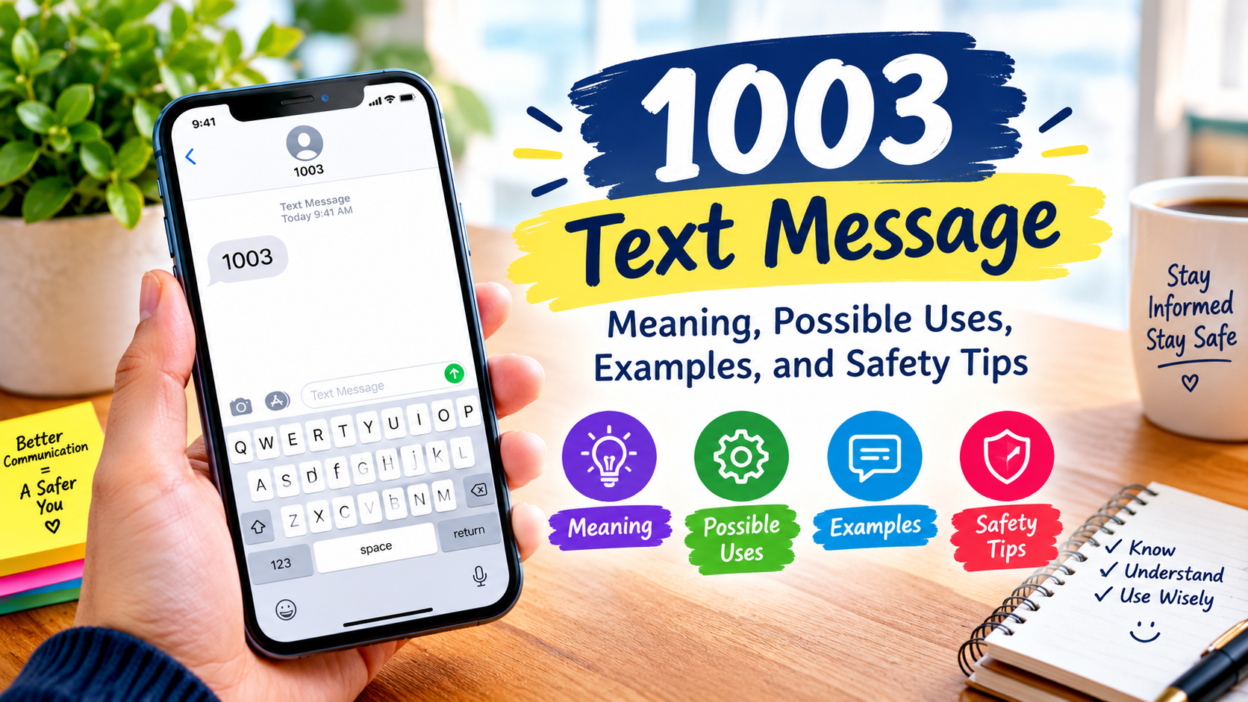
A 1003 text message can leave you wondering who sent it, why it appeared on your phone, and whether you need to respond. If you received a message containing the number 1003, the most important thing to understand is that the number doesn’t have one universally recognized meaning in texting.
Depending on the situation, 1003 could be a short code, an automated notification identifier, a reference number, or a number used within a particular service. It might also appear in a verification message, an account alert, or an ordinary conversation. However, the number alone isn’t enough to identify the sender or determine whether a message is legitimate.
The surrounding words, sender information, and any links included in the message provide more useful clues. For example, a message mentioning a login attempt requires a different response from a message containing a delivery update or an unfamiliar promotional offer.
This guide explains the possible meanings of 1003, how to investigate an unfamiliar message, what to do if you receive one unexpectedly, and how to protect your personal information.
🔎 What Does 1003 Mean in a Text Message?
The meaning of 1003 depends on where you saw it and how the sender used it. There isn’t enough evidence to assign this number one universal meaning across mobile networks, messaging apps, and businesses.
Here are some reasonable possibilities to consider:
- SMS short code: A business or service may use a short number to send automated notifications. However, you should verify whether 1003 belongs to the claimed organization.
- Verification or account alert: The number might appear within a message about signing in, confirming an account, or completing a transaction.
- Reference or confirmation number: A company could include 1003 in an order, support ticket, booking, or other internal reference.
- Ordinary text conversation: Someone might use the number as a personal code, inside joke, identifier, or part of a longer message.
- Technical error code: In software or messaging systems, 1003 can have a technical meaning unrelated to SMS slang.
For example, the WebSocket communication standard uses status code 1003 to indicate that a connection is closing because it received a type of data it cannot accept. That is a technical protocol meaning, not proof that an ordinary text from 1003 has the same meaning.
The key point: Don’t assume that 1003 identifies a particular company, mobile carrier, or texting abbreviation without additional evidence.
📱 Is 1003 a Texting Abbreviation or Slang Term?
People frequently search for number combinations because digital conversations use abbreviations, acronyms, and numerical expressions. Some numbers have established meanings in particular communities, while others are meaningful only to a specific person or service.
However, there is no reliably established, universal texting definition for 1003 that can be confirmed from the number alone.
Consider these examples:
Example message
Possible interpretation
“Your code is 1003”
A code or reference provided by a service
“Ticket number: 1003”
A support or service identifier
“Reply 1003 to confirm”
A service-specific instruction that requires verification
“1003 😂”
A private joke or context-dependent reference
“Error 1003”
A software or system error whose meaning depends on the product
These examples illustrate how the same number can appear in different situations. They are not evidence that 1003 has any particular assigned meaning.
If you found the number in a conversation with a friend, look at the surrounding messages. If it appeared in an automated notification, focus on the claimed sender and the action requested.
📨 Why Would You Receive a Message From 1003?
An unexpected message can have several explanations. The sender might be a legitimate organization, an automated messaging platform, or someone using a number that you don’t recognize.
1. An automated business notification
Companies often use SMS systems to deliver one-time passwords, account notifications, appointment reminders, and transaction updates. Some services send messages using numeric short codes rather than ordinary mobile numbers.
If your message mentions a service you recently used, compare its details with your recent activity. For example, a verification message might arrive shortly after you attempt to sign in.
Nevertheless, a familiar company name or convincing message does not independently prove authenticity.
2. A verification message you didn’t request
You might receive a login code after entering your phone number on a website or app. Alternatively, someone else could have entered your number by mistake or attempted to access an account associated with it.
If you didn’t initiate the request, don’t share the code with anyone. Open the relevant service independently if you need to check your account.
3. A marketing or subscription message
Businesses may send offers, promotional updates, or subscription notifications through SMS platforms. The message should provide enough information for you to understand the service and determine whether you opted in.
If you don’t recognize the business, avoid replying until you verify the sender and the instructions.
4. A mistaken or suspicious message
Sometimes messages reach the wrong person because of a typing error, an outdated contact record, or an incorrectly entered phone number.
In other cases, an unexpected message may be designed to make you click a link, reveal a verification code, or provide personal information. Therefore, treat unusual requests cautiously instead of assuming that every automated text is legitimate.
🛡️ Is a 1003 Text Message Safe or a Scam?
The number alone cannot tell you whether a message is safe. A legitimate service might send an unexpected notification, while a scammer might use a familiar-looking sender name or an ordinary phone number.
The message’s behavior offers more useful clues.
Signs that deserve verification, but may be legitimate
The message relates to an action you recently took, identifies a recognizable service, and can be independently confirmed through its official app or website.
Warning signs of a possible scam
The sender demands immediate payment, threatens account closure, asks for a password or one-time code, or pressures you to open an unfamiliar link.
Watch for messages that claim you have won an unexpected prize, owe an unfamiliar fee, or must verify sensitive information immediately. These tactics can be used to create urgency and reduce careful decision-making.
However, good spelling, a professional tone, and an apparently familiar sender aren’t guarantees of authenticity either.
When in doubt, contact the organization using contact information from its official website or app. Don’t use a phone number or link supplied only by the suspicious message.
🔍 How to Identify Who Sent the 1003 Text Message
You can investigate the message without immediately responding or clicking anything.
- Check the sender field. Open the message details and see whether 1003 appears as the sender, within the message body, or as part of a longer number. Those are different situations.
- Read the complete message. Look for a company name, transaction reference, account description, or explanation of why the message was sent.
- Review your recent activity. Consider whether you recently signed in to an account, requested a password reset, made a purchase, or subscribed to a service.
- Verify through an independent channel. Open the service’s official app or manually enter its known website address. Check account notifications or contact customer support if necessary.
- Ask your mobile carrier when appropriate. If you suspect an unknown short code or unexplained charge, ask your carrier whether it can identify the sender or investigate the message.
One important distinction: searching a number online may reveal reports about similar messages, but those reports can be incomplete or outdated. A website that lists short codes isn’t necessarily an official, current record of every code in use.
Likewise, a reverse-number lookup cannot reliably establish the identity of every automated sender.
If you are in Pakistan, remember that numeric short codes are used in SMS services, including business notifications. A code’s appearance alone does not confirm which organization sent it. Check with your network operator or the claimed business for verification.
💬 What Should You Do After Receiving a 1003 Message?
Your next step depends on the content of the text, not simply the number displayed.
Your situation
Recommended action
You recognize the service and expected the message
Verify the details through the official app or account
You receive an unexpected verification code
Don’t share it; review your account if necessary
The message includes an unfamiliar link
Avoid opening it until you verify the sender
It asks for payment or sensitive information
Don’t provide details through the message
You suspect spam or fraud
Save relevant evidence, report it, and block the sender if appropriate
You notice an unexplained charge
Check your account statement and contact your carrier or service provider
If the message contains a one-time password, remember that legitimate verification codes are intended to protect account access. Someone asking you to forward that code may be attempting to gain access to your account.
Similarly, if the message claims that a payment failed, check your account directly rather than following an unfamiliar payment link.
You don’t need to respond to every unknown text. In many cases, ignoring an unverified message is safer than engaging with it.
⚙️ Does 1003 Mean Something Different on Android and iPhone?
The basic interpretation process is similar on both devices. Neither Android nor iPhone automatically gives every unfamiliar numeric sender a universal texting meaning.
The practical differences mainly involve how you inspect, filter, and report messages.
On Android
Open the message and inspect the sender and content. In Google Messages, available options may include reporting spam, blocking a sender, and viewing message details. The exact options depend on your messaging app and device.
On iPhone
Review the conversation in Messages and use available options to report junk or block the sender. Some filtering and reporting features depend on your iOS version, carrier, and region.
In either case, reporting a suspicious message can help your messaging provider identify unwanted activity. However, blocking a sender won’t necessarily prevent messages from other numbers or sender IDs.
If you accidentally opened a suspicious link, don’t panic. Close the page, avoid entering information, and take additional steps if you downloaded a file or submitted sensitive details.
🌐 Could 1003 Be a Mobile Network Short Code?
Yes, a four-digit number can resemble a mobile network short code, but that resemblance doesn’t establish that 1003 is an officially assigned code for a particular carrier or company.
Short codes are used in different countries for services such as banking alerts, account verification, customer support, and promotional messaging. Their assignments and permitted uses vary by country and operator.
For that reason, don’t assume a code has the same owner or function in Pakistan, the United States, the United Kingdom, or another country.
If you’re trying to identify 1003 specifically, these details can help:
- Country: Where you received the text.
- Mobile network: Which carrier serves your SIM.
- Sender format: Whether the message came from exactly 1003 or contained that number elsewhere.
- Message content: The company name, instructions, and any reference number.
- Recent activity: Whether you recently used a service that might send automated SMS notifications.
A carrier’s official support team is a better starting point than guessing the sender’s identity from the digits alone.
🚫 Common Mistakes to Avoid When Investigating 1003
When an unfamiliar message appears, it’s easy to jump to conclusions. A few common mistakes can make the situation more confusing or create unnecessary risks.
Mistake 1: Assuming 1003 has one universal meaning. Numbers can function as short codes, reference IDs, or technical identifiers. Context matters.
Mistake 2: Trusting a message because it looks professional. Scammers can copy company logos, writing styles, and familiar notification formats. Verify the message independently.
Mistake 3: Replying immediately. Responding to an unknown sender may expose you to further unwanted contact. Verify the sender before engaging.
Mistake 4: Sharing a verification code. Don’t disclose a one-time password to a person who contacts you unexpectedly, even if they claim to represent customer support.
Mistake 5: Treating online lookup results as definitive. Third-party directories and discussion forums can contain incorrect or outdated information. Confirm important details with the relevant provider.
Mistake 6: Deleting all evidence too soon. If the message appears fraudulent, keep a screenshot and note the date and sender before reporting or deleting it. This can help if you need to contact your carrier or financial institution.
🔐 How to Protect Your Phone From Suspicious Text Messages
You don’t need to identify every unfamiliar number to protect yourself. A few consistent habits can reduce the risk of fraud.
- Keep your phone updated. Install security updates for your operating system and messaging apps.
- Use account protections. Enable multifactor authentication where available, preferably using a security key or authenticator when appropriate.
- Avoid sharing private information. Never send passwords, banking credentials, or one-time codes to an unverified contact.
- Check website addresses carefully. Scammers may use addresses that resemble legitimate businesses.
- Use spam-filtering features. Enable available message filtering and reporting tools on your phone.
- Monitor important accounts. Review banking, email, and mobile accounts if a suspicious message refers to activity you don’t recognize.
- Contact the real provider. Use its official app, website, or verified support channel to investigate unexpected notifications.
If you already provided a password, change it through the legitimate service and review active sessions. If you disclosed banking details or authorized an unfamiliar transaction, contact your financial institution promptly.
In addition, report suspicious messages to your mobile carrier or the relevant authority in your country. Reporting options differ by location, so use an official channel whenever possible.
❓ Frequently Asked Questions About 1003 Text Messages
1. What does 1003 mean when someone texts it to you?
There is no universally verified texting meaning for 1003. It could be a personal reference, a code used by a particular service, or part of a technical message. The surrounding conversation helps determine its likely meaning.
2. Is 1003 an official SMS short code?
A four-digit number can be used as an SMS short code, but the number alone doesn’t confirm an official assignment. Check with your mobile carrier or the organization that supposedly sent the message.
3. Is a text message from 1003 a scam?
Not necessarily. An unfamiliar numeric sender could be legitimate or suspicious. Look for warning signs such as requests for passwords, unexpected payment demands, urgent threats, and unverified links before deciding how to respond.
4. Why did I receive a 1003 verification code without requesting it?
Someone may have entered your number accidentally, or an individual may have attempted to initiate a login or account recovery. Don’t share the code. If you recognize the service, check your account through its official app or website.
5. Can I reply STOP to a message from 1003?
Only consider replying STOP when you’ve verified that the message is from a legitimate service and the instruction is appropriate. For an unknown or suspicious sender, avoid responding until you have confirmed its identity. You can also use your phone’s spam-reporting features.
6. Does 1003 have the same meaning on every mobile network?
No. Short-code assignments and messaging practices vary by country, carrier, and service provider. You should confirm the code’s purpose with the relevant organization instead of relying on an interpretation from another region.
7. What should I do if I clicked a link in a suspicious 1003 message?
Close the page and don’t enter further information. If you submitted a password, change it through the official service. If you provided financial details, contact your bank or payment provider. If you downloaded something, check your device for unfamiliar apps or files and seek trusted technical assistance if needed.
8. How can I find out who owns the number 1003?
Start with the complete message and sender details. Then check the claimed organization’s official website or contact your mobile carrier. Public directories may offer clues, but don’t treat an unverified listing as proof of ownership.
✅ Final Thoughts
The meaning of a 1003 text message depends on its context, sender, and purpose. Although the number resembles a short code, it doesn’t establish a particular company, texting abbreviation, or scam by itself. Read the complete message, consider your recent account activity, and verify unfamiliar notifications through official channels. Most importantly, don’t share passwords or verification codes, and avoid clicking suspicious links. If the sender remains unidentified, your mobile carrier may be able to help investigate.