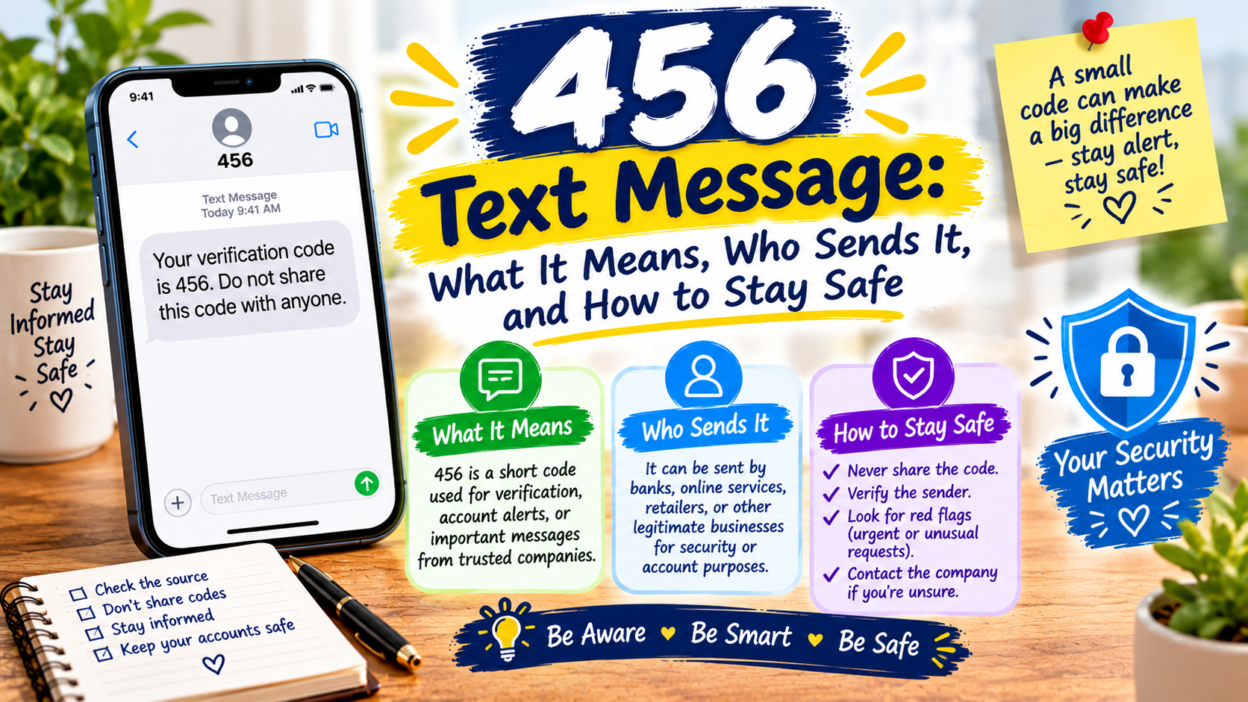
When a 456 text message appears on your phone, you may wonder who sent it, why it arrived, and whether you need to respond. Short numeric codes can be confusing because they don’t look like ordinary phone numbers or familiar texting abbreviations.
The meaning of a message from 456 depends on its content, your mobile carrier, and the service associated with the message. It could relate to a notification, an automated communication, a service alert, or another system that uses a short sender ID. However, the number alone doesn’t establish who sent the message or whether it’s legitimate.
This guide explains how to investigate a 456 text message, recognize possible warning signs, understand the difference between a sender ID and a message code, and decide what to do next. You’ll also learn how to handle unexpected links, protect your personal information, and verify suspicious messages without putting your accounts at risk.
📱 What Does a 456 Text Message Mean?
The most useful interpretation depends on where you live and which mobile network you use. In the United States, 456 is officially listed by T-Mobile as a T-Mobile Alerts code. The company’s support page also notes that messages sent to 456 may receive an automated reply explaining that the channel isn’t monitored.
- t-mobile.com
- Here are the main possibilities to consider.
- Possible meaning
- What it may indicate
- T-Mobile alert
- A carrier-related notification or service message
- Automated SMS
- A message generated by a system or service
- Numeric texting slang
- A number used as shorthand in a particular language or online community
- Unrecognized sender
- A message whose source needs further verification
- Importantly, these possibilities aren’t interchangeable. A message from the short code 456 is different from a friend typing “456” inside a conversation.
For example, if you use T-Mobile and receive a service notification from 456, the carrier’s official documentation is a useful starting point. However, if a friend sends you those three digits in a casual chat, the meaning may depend on their language and online habits.
Does 456 have a meaning in Chinese texting?
Yes. In some Chinese-language online conversations, the number 456 can represent the phrase which means “It’s me.” This interpretation comes from the way numbers sound when spoken in Chinese.
What Does 456 Mean?
Nevertheless, this slang interpretation doesn’t automatically explain a text received from the sender ID 456. The message’s context determines which meaning is relevant.
🔎 Why Would You Receive a Text From 456?
There isn’t one explanation for every message. Instead, consider your recent activity and the wording of the text.
1. You use T-Mobile mobile service
If you’re a T-Mobile customer in the United States, this is the first possibility to investigate. T-Mobile lists 456 among its alert codes, so a message associated with your mobile service may be legitimate.
Check whether the message mentions a network notification, service information, or another activity you recognize. If anything seems unusual, confirm it through your carrier’s official app or support channels.
2. You recently changed a service or account setting
Some automated messages arrive after customers update their settings, request information, or interact with a service. However, don’t assume that every unexpected text relates to a recent action.
Instead, compare the message with your actual account activity. If the text describes a change you didn’t make, verify it independently.
3. You’re seeing a number used as slang
In a personal conversation, numeric expressions can replace words or phrases. The sender may be using a language-specific expression, a private joke, or a convention shared with friends.
For example, someone familiar with Chinese numerical slang might use 456 to communicate “It’s me.” Someone unfamiliar with that convention might simply see three unrelated digits.
4. The message may be unwanted or deceptive
Unexpected texts can also be spam or phishing attempts. A message may imitate a familiar company, mention a problem with your account, or encourage you to open an unfamiliar link.
The sender number alone isn’t enough to prove that a message is genuine. Therefore, investigate suspicious requests before taking action.
🛡️ Is the 456 Text Message Legitimate or a Scam?
The number 456 is associated with legitimate T-Mobile alerts, but you should still evaluate the specific message. A recognized sender ID doesn’t guarantee that every message displayed on your phone is trustworthy.
Use the following comparison to assess what you’ve received.
Sign
What to consider
Relevant service information
Does it match your carrier or recent activity?
Unexpected urgency
Does it threaten immediate suspension or demand instant payment?
Suspicious link
Does it send you to an unfamiliar or misspelled website?
Request for credentials
Does it ask for your password or a one-time security code?
Unrecognized account activity
Does it describe a change you didn’t authorize?
One warning sign doesn’t always prove fraud. For example, legitimate companies sometimes send urgent service notifications. Nevertheless, requests for passwords, payment through unusual methods, or confidential verification codes deserve particular caution.
The safest approach is to verify the claim independently. Open your carrier’s official app, visit its website by typing the address yourself, or contact support using a trusted number.
Don’t use contact details supplied only in a suspicious message.
✅ What to Do When You Receive a 456 Text Message
If you’re unsure about the message, follow these practical steps.
1. Read the entire message
Check its wording, purpose, and any instructions. Don’t make a decision based solely on the number displayed above the message.
2. Identify the relevant service
If the message appears carrier-related, check your mobile provider. If it mentions another company, verify the claim through that company’s official channels.
3. Avoid risky links and requests
Don’t disclose passwords, banking information, or verification codes in response to an unexpected message. Navigate to the relevant service independently.
4. Contact the provider if needed
Ask the provider whether it sent the message. Use a support channel from its official website or app, rather than relying on an unknown contact number.
5. Report or block suspicious messages
If the message is unsolicited or clearly deceptive, use your phone’s reporting and blocking features. You can also ask your carrier how to report unwanted texts.
These steps help you avoid unnecessary worry while protecting your personal information. You don’t need to reply to an unfamiliar message just to discover who sent it.
💬 Should You Reply to a Text From 456?
In most cases, you should verify the sender before replying to an unfamiliar message. Whether a response is appropriate depends on the service and the message’s purpose.
T-Mobile specifically notes that messages sent to 456 may receive a response explaining that the channel isn’t monitored and directing customers to its Messaging department.
Therefore, if you received a T-Mobile alert, don’t assume that replying will connect you with customer service. Use the official support options instead.
For messages containing suspicious links, payment requests, or demands for confidential information, avoid engaging with the sender.
Here are some practical guidelines:
- Reply when appropriate: Respond to a person you recognize or a verified service that supports two-way messaging.
- Don’t reply automatically: An unfamiliar message doesn’t require an immediate response.
- Avoid sending personal details: Never share passwords or security codes simply because a message requests them.
- Verify first: If you’re uncertain, contact the relevant company through a trusted channel.
Also, be careful with instructions to reply with words such as STOP or YES. Although legitimate messaging services use these commands, you should establish which service sent the message before following unexpected instructions.
🌐 Does 456 Mean the Same Thing on Every Phone Network?
No. The meaning of a numeric sender ID can depend on the country, carrier, and messaging service.
In the United States, T-Mobile’s documentation identifies 456 as one of its alert codes. However, that fact doesn’t establish that the same number has the same purpose on every network worldwide.
This distinction matters for international readers. Messaging systems and sender identifiers can vary across countries, so an explanation written for one carrier may not apply to another.
Consider these situations:
- A T-Mobile customer in the United States: Check the message against official T-Mobile service information.
- A customer using another US carrier: Contact that carrier if the message appears connected to your account.
- A mobile user in Pakistan or another country: Verify the sender with your own provider rather than assuming the US interpretation applies.
- A person chatting with friends: Consider whether 456 is being used as numeric slang or an inside joke.
Furthermore, your phone’s operating system doesn’t determine the meaning of the sender code. An iPhone and an Android phone may display the same incoming message, but the context and sender still determine its purpose.
⚠️ What If You Accidentally Clicked a Link in a 456 Message?
Don’t panic. Clicking a link doesn’t automatically mean your device or account has been compromised. Your next steps should depend on what happened after you opened it.
If you only opened the page, close it and avoid downloading files or entering information. Then check whether the page requested permissions or attempted to install anything.
If you entered a password, change it through the service’s official website or app. If you reused that password elsewhere, update those accounts as well.
If you shared a verification code, contact the affected service immediately. Review recent sign-ins, end unfamiliar sessions when possible, and strengthen your account security.
If you entered payment or banking information, contact your financial institution using its official contact details. Explain what happened and ask whether you should freeze a card, block a transaction, or take additional protective steps.
Finally, report the message if it appears fraudulent. Your carrier or messaging app may offer a way to flag suspicious texts.
The important lesson is simple: respond quickly to the actual risk, not to the fear created by the message.
🔐 How to Protect Yourself From Suspicious Text Messages
Good messaging habits reduce the chances of falling for phishing attempts, regardless of the sender number.
Check the claim independently
If a text claims that your account has a problem, open the official app or website yourself. A legitimate service should provide a way to review relevant account information.
Protect verification codes
One-time codes are often designed to confirm that you control an account or phone number. Don’t share them with someone who contacts you unexpectedly, even if that person claims to represent customer support.
Keep your phone updated
Install operating system and security updates when available. Updates help address known vulnerabilities and improve device protection.
Limit engagement with suspicious senders
Don’t follow links, download unexpected attachments, or provide personal details simply because a message appears urgent. Report and block suspicious messages when appropriate.
Review your account activity
If a text mentions a login, purchase, or account change, check the relevant service directly. This helps you distinguish a genuine notification from an attempt to frighten you into taking action.
These habits are useful for carrier alerts, banking notifications, delivery messages, and other forms of digital communication.
🧩 Common Mistakes People Make About 456 Text Messages
When an unfamiliar number appears on a phone, it’s easy to jump to conclusions. However, a few common misunderstandings can make the situation more confusing than necessary.
Mistake 1: Assuming every message from 456 is a scam.
T-Mobile officially lists 456 as an alert code. Therefore, a message associated with that carrier may be legitimate. Still, verify the specific message rather than trusting it automatically.
Mistake 2: Assuming every message from 456 is safe.
A familiar-looking number isn’t sufficient proof of authenticity. Review the content and independently confirm any unusual requests.
Mistake 3: Confusing a sender ID with texting slang.
The number displayed as a sender and the number someone types into a conversation serve different purposes. Context helps distinguish a carrier notification from a numeric expression such as the Chinese texting slang described earlier.
Mistake 4: Replying just to find out who sent it.
An unfamiliar number doesn’t require a response. In particular, T-Mobile says messages sent to 456 may receive an automated response because the channel isn’t monitored.
Mistake 5: Ignoring an alert about genuine account activity.
Although caution is important, dismissing every unexpected message isn’t ideal either. If the message mentions a real account change, review that activity through the official service.
The best approach combines caution with verification. You don’t have to trust an unfamiliar text, but you also don’t need to assume the worst.
📋 How to Identify the Meaning of Your Specific 456 Message
Use this quick reference to decide what to investigate first.
Your situation
Recommended action
You use T-Mobile and received a service alert
Compare the message with your account and official carrier information
You don’t recognize the sender
Avoid clicking links and verify the source
A friend typed 456 in a conversation
Ask what they mean or consider the language and conversation context
The message requests a password or security code
Don’t share it; verify the request independently
You see an unfamiliar account transaction
Check the account directly and contact the provider if necessary
You replied and received an automated response
Use the provider’s official support channel instead
This approach is more reliable than searching for the number alone. The sender, message wording, country, and recent activity together provide better clues about its meaning.
❓ Frequently Asked Questions About the 456 Text Message
1. What is the 456 text message?
A 456 text message is an SMS associated with the short sender code 456. In the United States, T-Mobile lists 456 among its alert codes. The exact meaning of a particular message depends on its content and context.
t-mobile.com
2. Is 456 an official T-Mobile number?
Yes, T-Mobile’s official support documentation lists 456 as one of its alert codes. However, you should still verify unexpected requests through the carrier’s official channels rather than assuming every message is trustworthy.
t-mobile.com
3. Is a text from 456 dangerous?
Not necessarily. The number is associated with legitimate T-Mobile alerts, but the sender ID alone doesn’t establish whether a specific message is safe. Be cautious with unexpected links, requests for passwords, and demands for payment.
4. Why can’t I get a response when I text 456?
T-Mobile explains that messages sent to 456 may receive an automated response indicating that the channel isn’t monitored. If you need assistance, contact the carrier through its official support options.
5. Does 456 mean “It’s me” in texting?
In some Chinese-language online conversations, 456 represents meaning “It’s me.” This interpretation relies on similarities between the spoken numbers and the Chinese phrase. It doesn’t automatically explain a message received from the sender ID 456.
6. Should I delete a message from 456?
If the message is suspicious, you can report and delete it after preserving any information needed to document a potential scam. If it appears to be a legitimate carrier alert, review its content first so you don’t overlook relevant service information.
7. What should I do if the message asks for my verification code?
Don’t share the code with the sender. Open the relevant account independently, review recent activity, and contact the service if you suspect someone is attempting to access your account.
8. Can I block messages from 456?
Your phone may let you block or report a sender, although available options vary by device and carrier. Before blocking it, consider whether the messages are legitimate service alerts you want to receive. Your carrier can explain which filtering options are available.
📝 Final Thoughts on the 456 Text Message
A 456 text message doesn’t have one universal meaning in every situation. In the United States, T-Mobile identifies 456 as an alert code, while the same digits can have a different meaning in a personal conversation or another messaging context. The key is to evaluate the actual message instead of judging it by its number alone. If you recognize the service, verify the details through official channels. If the message contains suspicious links, requests for confidential information, or unexpected payment demands, proceed carefully. With a few simple checks, you can understand unfamiliar texts, protect your accounts, and decide what to do without unnecessary worry.