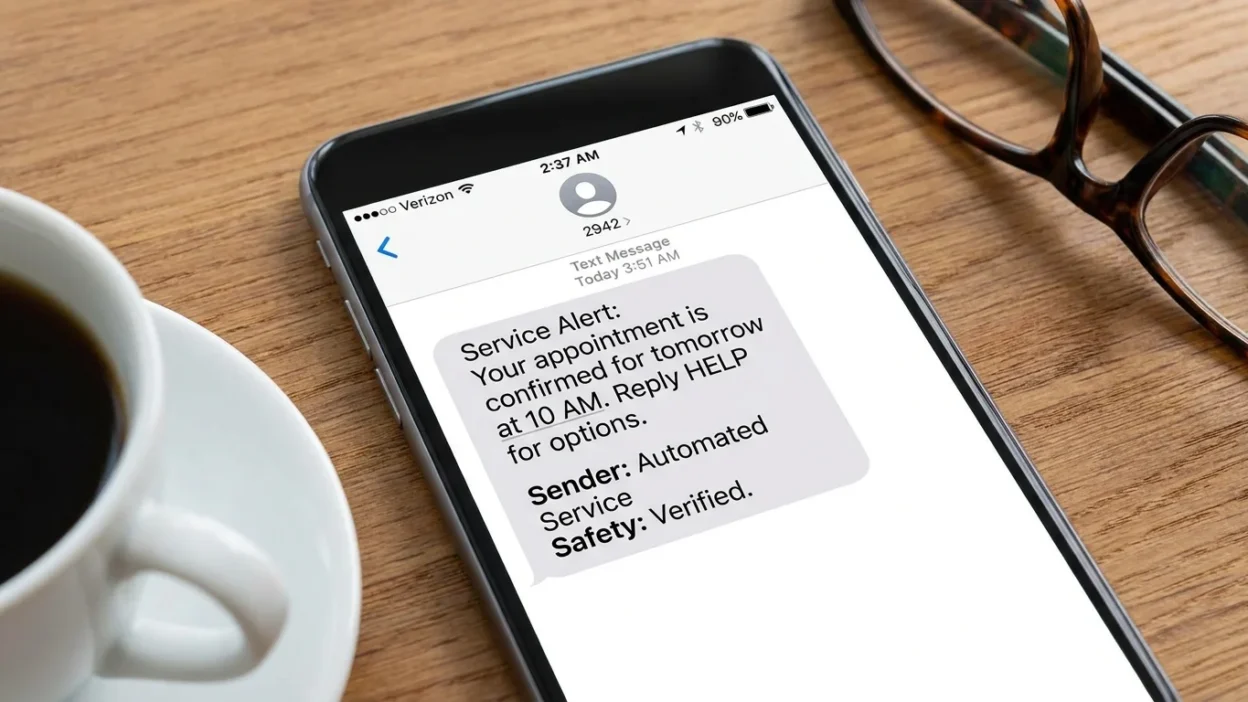
If you received a 2942 text message, you may be wondering what the number means, who sent it, and whether you should trust it. In many cases, 2942 may appear as a verification code or as an SMS sender ID, so the number alone does not identify one specific company. The safest way to understand the message is to examine its wording, the service mentioned, and whether you recently requested a login or verification code.
An unexpected 2942 message can be harmless. For example, someone may have accidentally entered your phone number while signing up for an account. On the other hand, an unsolicited security code can sometimes indicate that someone is attempting to access an account associated with your number.
Fortunately, you do not need to panic. You can usually determine what to do by checking whether you initiated the action, avoiding suspicious links, and never giving a one-time password to another person. This guide explains the possible meanings of a 2942 text message, how verification codes work, common scam signs, and the safest steps to take on iPhone and Android.
📱 What Is a 2942 Text Message?
A 2942 text message is an SMS in which 2942 appears either as the sender identifier or as a number contained within the message. These are two different situations, and confusing them can lead to incorrect assumptions about who sent the text.
For instance, you might receive a message saying that your verification code is 2942. In that case, 2942 is the temporary security code, not necessarily the sender.
Alternatively, your phone may display 2942 as the sender. That does not automatically establish which company operates the number because SMS routing and sender identification can vary by service and country.
Therefore, look at the complete message rather than judging it by four digits alone.
🔎 Why Did I Receive a 2942 Text Message?
There are several ordinary reasons you might receive an unexpected message containing 2942.
You may have recently:
- 🔐 Tried to log into an account
- 📝 Created a new account
- 📱 Added or verified a phone number
- 🔄 Requested a password reset
- 👤 Attempted to recover an account
- 🛡️ Triggered a security verification
- ❌ Had someone enter your number by mistake
If the message arrived immediately after something you did, it may be a legitimate automated notification.
However, if you were not doing anything related to the stated service, do not assume the message belongs to you. Someone could have entered your phone number accidentally, or an unknown person could be attempting an account action.
🔐 Is 2942 a Verification Code?
Yes, 2942 can be used as a verification code. A four-digit number appearing in an authentication message is commonly a one-time password or verification code.
The important question is not simply whether the code is 2942. Instead, ask yourself whether you requested the code.
If you requested it, enter the code only in the legitimate service where you started the login, registration, or recovery process.
If you did not request it, simply leave the code unused. Never forward it to someone who contacts you asking for it.
🎮 Does 2942 Belong to WePlay?
A message containing 2942 may be associated with a WePlay verification process, but seeing the number does not prove that every 2942 message comes from WePlay.
Verification systems generate temporary codes, and the same digits can potentially appear in unrelated SMS messages. Therefore, it is better to identify the service from the actual message rather than assuming that 2942 permanently belongs to one company.
If a message specifically mentions WePlay and you recently attempted to sign in, the code may be connected to that activity. If you did not initiate anything, do not use or share the code.
⚠️ Is a 2942 Text Message a Scam?
A 2942 text message is not automatically a scam. The sender number by itself is not enough evidence to determine whether a message is legitimate.
Instead, look for warning signs within the SMS.
Be especially cautious if the message:
- 🚨 Creates extreme urgency
- 🔗 Contains an unfamiliar link
- 💳 Requests payment information
- 🔑 Requests your password
- 🔐 Asks you to provide a verification code
- 🎁 Promises an unexpected reward
- 📞 Tells you to call an unfamiliar number
- 🪪 Requests sensitive personal information
- 👤 Claims to be customer support without you contacting them
A legitimate security message can still be unexpected. However, a message that pressures you to reveal sensitive information deserves extra caution.
✅ How to Tell If a 2942 Text Is Legitimate
You can perform a quick safety check before interacting with the message.
1. Think about what you recently did
Did you just sign into an account or request a verification code?
If yes, the message may make sense.
If not, there is less reason to trust it.
2. Read the entire SMS
Look for the name of the service, reason for the code, expiration information, and instructions.
Do not focus only on “2942.”
3. Check the destination independently
If the text includes a link, do not automatically open it.
Instead, launch the official app or manually visit the service’s legitimate website.
4. Never surrender authentication codes
A legitimate service may send you a code. That does not mean another person should receive it.
Keep the code private.
5. Watch for pressure
Urgent language such as “act immediately” or “your account will be closed” can be a phishing tactic.
Take a moment to verify before doing anything.
🛑 What Should I Do If I Didn’t Request the 2942 Code?
If you received a 2942 verification code that you did not request, the safest first step is simple: do not share it.
You generally do not need to respond to the message. Let the code expire if you have no legitimate reason to use it.
If the message identifies a service you recognize, you can independently open that service and review your account security.
For repeated unexpected codes, consider:
- 🔍 Checking recent account activity
- 🔑 Changing your password
- 🛡️ Enabling stronger authentication
- 📱 Confirming your phone number is secure
- 🚫 Blocking or reporting unwanted messages
Receiving a code does not automatically mean someone has successfully entered your account. In many authentication systems, the attacker still needs the code to complete the sign-in process.
🚫 What If Someone Asks for My 2942 Code?
Do not give it to them.
This is one of the most important rules for handling verification texts.
Someone may claim they are:
- 👨💼 A customer-service employee
- 🏦 A bank representative
- 👤 A friend
- 🛠️ Technical support
- 🔐 An account-security specialist
Their claim does not make the request safe.
A verification code is intended to prove that the authorized user has access to the phone number or account. Sharing it can allow another person to complete an authentication process.
If someone legitimately needs to help you with an account, contact the company through its official support channel instead.
🔗 What If the 2942 Text Contains a Link?
Treat links in unexpected texts with caution.
Phishing messages often imitate familiar businesses and use links to direct people to fake login pages. The page may look convincing while actually collecting passwords or payment information.
Instead of clicking:
- 📱 Open the official app yourself.
- 🌐 Visit the company’s website independently.
- 🔐 Sign in normally.
- 🔎 Check for account alerts or notifications.
- 📩 Contact official support if something still looks wrong.
You should never rely solely on the branding or company name shown inside an SMS.
🧯 What If I Already Clicked the Link?
Do not panic if you clicked a suspicious link.
Your next steps depend on what happened afterward.
If you only opened the page: Close it and do not enter additional information.
If you entered a password: Change the password through the legitimate website or app. If you reused that password elsewhere, change those accounts too.
If you entered financial information: Contact your bank or financial institution using a trusted phone number or official website.
If you downloaded something: Do not open an unfamiliar file or application. Remove it if appropriate and review your device’s security settings.
If you gave someone your verification code: Secure the affected account immediately and review recent login activity.
The faster you act after exposing sensitive information, the better.
💬 Should I Reply to a 2942 Text?
Usually, you should not reply to an unexpected 2942 message until you know exactly who sent it.
If you requested a verification code, you generally do not need to reply. Instead, enter the code into the official service that requested it.
If an unfamiliar message asks you to respond with “YES,” confirm personal information, or follow additional instructions, stop and verify the sender first.
A reply alone may also confirm that your number is active, depending on the type of message and sender.
📩 Can 2942 Texts Be Spam?
Yes, an individual message containing 2942 can be unwanted spam, but that does not mean every message involving 2942 is spam.
Spam usually becomes easier to identify when the message is unrelated to anything you have done.
For example, be cautious when a text:
- 📢 Promotes something you never requested
- 🎁 Offers a prize you never entered to win
- 💰 Claims you have an unexpected payment
- 🔗 Sends you to an unfamiliar website
- 📞 Tells you to contact an unknown number
- 🔐 Requests confidential information
When several warning signs appear together, avoid interacting with the message.
🚩 2942 Text Message Red Flags
A suspicious text often tries to make you react before you have time to think.
Watch for phrases suggesting that you must act immediately.
Other warning signs include:
- Unexpected account suspension warnings
- Fake delivery problems
- Unrecognized payment alerts
- Requests for gift cards or money
- Password-reset messages you did not request
- Strange spelling or awkward wording
- Links with unfamiliar domains
- Requests for one-time passwords
However, grammar alone should not determine whether a message is safe. Some legitimate automated texts can also contain awkward wording.
The strongest warning signs are unexpected requests for money, credentials, authentication codes, or sensitive information.
🔢 2942 Sender vs. 2942 Verification Code
This distinction is especially important.
A 2942 sender means your messaging application displays 2942 as the sender identifier.
A 2942 verification code means the four digits appear within the message as a temporary authentication number.
Your verification code is 2942.
Here, 2942 is the code.
The sender could be a company name, another short code, or another SMS identifier.
So, if you see 2942 inside a message, do not automatically conclude that 2942 is the sender.
🎮 What Does 2942 Mean in a WePlay Text?
If your SMS mentions WePlay and identifies 2942 as a verification code, the number may be part of the service’s authentication process.
This usually means the system is attempting to verify access to the phone number.
If you recently initiated the process, use the code only within the legitimate WePlay service.
If you did not initiate it, leave the code unused and do not give it to anyone.
Most importantly, do not assume that every text containing 2942 is related to WePlay.
🔐 Could Someone Be Trying to Access My Account?
Possibly, but an unexpected verification code does not prove that someone successfully accessed your account.
For example, someone might enter your phone number on a login screen. The service then sends a code to your phone. Without that code, the person may be unable to complete the authentication step.
However, repeated unexpected codes should not be ignored.
If you recognize the service, sign in independently and check:
- Recent login activity
- Connected devices
- Password changes
- Recovery information
- Security alerts
- Two-factor authentication settings
If something looks unfamiliar, secure the account immediately.
🔄 What If I Keep Receiving 2942 Messages?
Repeated messages require a more careful review.
First, determine whether every message comes from the same service. The wording and sender information can provide useful clues.
Next, check accounts that use your phone number for authentication.
If you find unfamiliar login attempts, change the relevant password and enable stronger security options.
You can also use your phone’s built-in tools to report or block unwanted messages.
If the messages appear connected to fraud or attempted account takeover, preserve screenshots and other relevant information before deleting anything.
🚫 Should I Block 2942?
Blocking can be useful when the messages are clearly unwanted and continue.
However, you should not block a sender simply because you received one legitimate verification message.
If you are using a service that sends authentication codes through that sender, blocking it could interfere with future account recovery or login attempts.
Therefore, identify the source first. If the messages are clearly unsolicited, blocking and reporting may be reasonable.
📣 How to Report a Suspicious 2942 Text
If you believe a message is spam or phishing, use the reporting features available in your messaging application.
Depending on your phone and carrier, you may see options such as:
- 🚨 Report spam
- 🗑️ Report junk
- 🚫 Block sender
- 📩 Forward spam to your carrier’s reporting service
If the message involves financial fraud or attempted identity theft, keep evidence such as screenshots and timestamps.
Do not use a phone number or website supplied by the suspicious text to report the incident. Find the organization’s official contact information independently.
🍎 2942 Text Message on iPhone
On an iPhone, review the message carefully before interacting with it.
Depending on your iOS version and messaging setup, Messages may provide options for identifying or reporting unwanted texts and blocking a sender.
If the message looks suspicious:
- 📸 Take a screenshot if you need evidence.
- 🔗 Avoid opening unfamiliar links.
- 🚫 Use available spam or blocking features.
- 🔐 Check the relevant account independently.
- 🗑️ Delete the message after preserving necessary evidence.
Remember that an iPhone’s display of a sender name or number does not automatically prove that the message is trustworthy.
🤖 2942 Text Message on Android
Android devices also offer spam detection, blocking, and reporting features, although the exact interface varies between manufacturers and messaging applications.
If your messaging app marks a message as suspicious, take the warning seriously.
Before clicking anything, consider whether you actually requested the message.
You can generally use your messaging application’s available options to report or block unwanted texts. If the SMS concerns an important account, however, verify that account separately before taking action.
🔑 Why Do Companies Send Verification Codes by Text?
Businesses use SMS verification to confirm that someone has access to a particular phone number.
A code may be triggered when you:
- Create an account
- Sign in from a new device
- Reset a password
- Recover an account
- Change security settings
- Verify a phone number
The code is normally temporary.
That temporary nature is important because it limits how long the authentication information remains useful. Nevertheless, you should always treat the code as confidential.
⏱️ Can a 2942 Verification Code Expire?
Yes. Verification codes are commonly designed to remain valid for only a limited period.
If you requested the code, use it promptly through the legitimate service.
If you did not request it, there is no reason to try using it. Simply allow it to expire.
Never assume that an expired code becomes safe to share. The better practice is to keep authentication codes private from the beginning.
🧾 What If I Accidentally Entered 2942 Somewhere?
The answer depends on where you entered it.
If you entered 2942 into the official app or website you intentionally accessed, there may be nothing wrong.
However, if you entered the code into an unfamiliar website or gave it to another person, take action quickly.
Start by securing the associated account through its official website or app. Change your password if appropriate and review recent account activity.
If you also provided banking information, identification details, or another sensitive credential, contact the relevant organization through an independently verified channel.
🧠 Common Mistakes to Avoid With 2942 Texts
Several mistakes can turn a harmless message into a security problem.
- A number appearing in one verification message does not prove universal ownership.
- Never forward a one-time verification code because someone says they need it.
- Verify unexpected links before opening them.
- An unexpected code does not automatically mean your account has been compromised.
- Repeated codes can be a reason to review your account security.
- Scammers can imitate the appearance and language of well-known companies.
🛡️ How to Stay Safe From Unexpected Verification Texts
Good account-security habits can reduce the risk of problems caused by suspicious SMS messages.
Use unique, strong passwords for important accounts. Whenever available, enable stronger authentication methods rather than relying solely on SMS.
Also, keep your phone and apps updated. Software updates can include important security fixes.
Finally, develop one simple habit: never give an authentication code to another person.
That rule alone can prevent many account-takeover attempts.
📋 Quick Safety Checklist for a 2942 Text Message
When you receive a suspicious or unexpected SMS, use this checklist:
- ✅ Did I request this code?
- ✅ Do I recognize the service?
- ✅ Does the message explain why I received it?
- ❌ Does it ask for my password?
- ❌ Does someone want me to send them the code?
- ❌ Does it contain a suspicious link?
- ❌ Is it demanding immediate payment?
- 🔍 Can I verify the information through the official app?
- 🚫 Should I report or block the message?
If you cannot verify the message, the safest choice is to avoid interacting with it.
📌 What You Should Remember About a 2942 Text Message
The number 2942 does not have one universal meaning.
It can appear as a sender identifier or as a temporary verification code. Therefore, identifying the exact service requires looking at the full SMS and considering what you were doing when the message arrived.
If you requested a code, use it only through the legitimate service. If you did not request it, do not share it, do not click unfamiliar links, and consider reviewing the relevant account.
Most importantly, don’t let an unexpected text pressure you into making a quick decision. A few moments spent verifying the message can protect your account and personal information.
❓ Frequently Asked Questions About 2942 Text Messages
What is a 2942 text message?
A 2942 text message is an SMS where 2942 appears as a sender identifier or as a number within the message. Its exact meaning depends on the context and wording.
Is 2942 a verification code?
It can be. Four-digit numbers such as 2942 are commonly used as temporary verification codes. If you received one unexpectedly, do not share it.
Is a 2942 text message a scam?
Not necessarily. The number alone cannot prove that a message is fraudulent. Look for suspicious links, payment requests, credential requests, and other warning signs.
Why did I receive a 2942 verification code?
You may have requested a login, registration, password reset, or phone-number verification. If you did not request it, someone may have entered your number accidentally or initiated an account action.
Should I share my 2942 verification code?
No. One-time verification codes should remain private. Never give one to someone who contacts you unexpectedly.
What should I do if I didn’t request the 2942 code?
Do not use or share the code. If you recognize the service, independently check your account and review security activity. Repeated messages may justify changing your password and strengthening account security.
Does 2942 belong to WePlay?
2942 may appear in WePlay verification messages, but that does not prove that every SMS containing 2942 is from WePlay. Always evaluate the complete message.
What if my 2942 text contains a link?
Do not click an unexpected link. Instead, open the company’s official app or website independently and check whether the claimed account issue actually exists.
Should I block 2942?
If the messages are clearly unwanted and continue, blocking or reporting the sender can be appropriate. However, identify the source first if you rely on that sender for legitimate security messages.
Can someone access my account just because I received a 2942 code?
Not necessarily. An unexpected code can mean someone initiated a login or registration attempt, but the person may still need the code to complete authentication. Never share it.
Final Verdict
A 2942 text message can represent a verification code, an SMS sender identifier, or an unwanted message, so the four-digit number alone cannot tell you whether the text is legitimate. The safest approach is to consider the complete message, remember whether you initiated the activity, and verify any account notification independently. If you requested the code, use it only through the legitimate service; if you did not, don’t share it, avoid suspicious links, and review your account if unexpected messages continue. With these simple precautions, you can handle a 2942 text message without unnecessary panic while keeping your accounts and personal information safer.