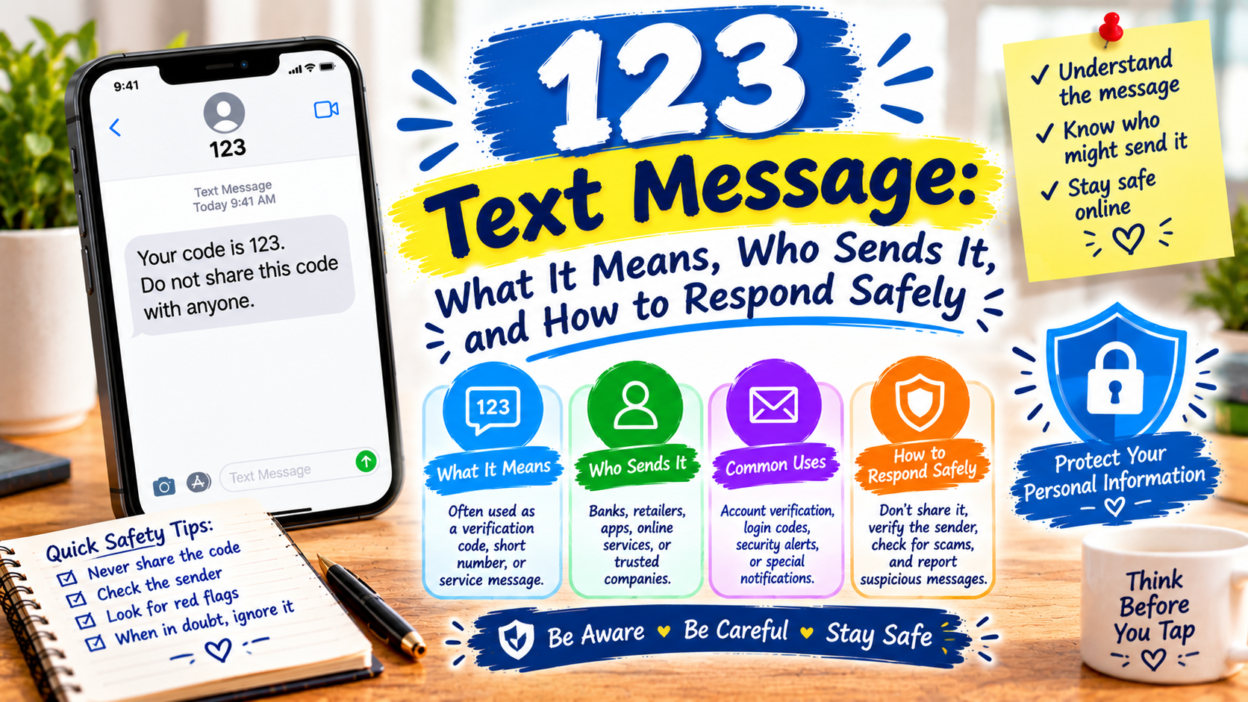
A 123 text message can have different meanings depending on who sends it, what the message says, and where you receive it. You might see “123” in a casual conversation, receive a message from a short code, or notice these numbers in an automated notification. Although the number looks simple, its meaning isn’t always obvious.
In everyday texting, people often use “123” to represent a sequence, simplify an instruction, or refer to something numbered. In other situations, a message containing these digits might come from a business, an automated messaging service, or an unfamiliar sender. Therefore, the surrounding context matters more than the number alone.
If you received a 123 text message unexpectedly, you may be wondering whether it’s legitimate, promotional, or potentially a scam. The safest approach is to examine the sender, read the complete message, and avoid clicking unfamiliar links until you understand its purpose.
This guide explains the possible meanings of 123 in text messages, common uses, examples, sender identification, and practical safety precautions. You’ll also learn how to respond appropriately without sharing personal information or taking unnecessary risks.
🔎 What Does 123 Mean in a Text Message?
The number 123 doesn’t have one universally accepted meaning in digital communication. Instead, its interpretation depends on the conversation or messaging service involved.
Here are some common possibilities:
- A simple number sequence: Someone may use 123 when counting, listing items, or explaining steps.
- An easy or basic process: In phrases such as “as easy as 123,” the number suggests simplicity.
- A numbered instruction: A message might use 123 as shorthand for an ordered sequence or reference.
- A code or identifier: Businesses and automated systems may include numbers to identify a service, transaction, or message source.
- A personal reference: Friends might use 123 as an inside joke, a memorable number, or part of a shared conversation.
However, these possibilities don’t establish the meaning of every message containing 123. The digits alone cannot confirm who sent the message, which service uses them, or whether the communication is trustworthy.
For example, “Follow steps 1, 2, and 3” uses the number as an instruction. By contrast, “Your verification code is 123456” would serve a different purpose, although you should never assume a code is legitimate simply because it contains numbers.
The key point: Interpret 123 using the full message and the sender’s identity rather than assuming it represents a specific texting abbreviation.
💬 Does 123 Mean “I Agree” or “I Love You”?
In some online slang references, 123 is listed as a way to say “I agree.” It may also appear with a question mark, as in “123?”, when someone asks whether another person agrees. Some references mention “I love you” as a less-established interpretation, but this meaning isn’t universal.
What Does 123 Mean?
These interpretations are different from the ordinary use of 123 as a number. As a result, you shouldn’t automatically interpret a friend’s message as agreement or affection without considering the conversation.
Consider these examples:
Text message
Possible interpretation
“123, that’s exactly what I thought!”
Agreement, if both people recognize the slang
“123?”
A possible request for agreement
“Count 123 before you start.”
A literal number sequence
“I love you ❤️”
A clear expression of affection without ambiguous number slang
The first two examples rely on a niche interpretation of internet slang. If the recipient hasn’t encountered it before, the meaning may not be obvious.
Practical tip: If someone sends you “123” without explanation, ask what they mean rather than guessing. A short clarification can prevent confusion, especially in a new friendship or an important conversation.
📱 Is 123 a Texting Abbreviation or a Short Code?
The distinction between texting slang and a messaging short code is important because the two serve different purposes.
A texting abbreviation is a shortened expression people use in conversation. A short code, on the other hand, is a numeric address that messaging services may use to send or receive texts. In the United States, business SMS short codes commonly contain five or six digits.
The number 123, by itself, doesn’t establish that a message came from a registered business or official service.
Feature
Texting slang
SMS short code
Main purpose
Express an idea or reaction
Send or receive service messages
Where it appears
Usually inside a conversation
Often in the sender field or service instructions
Who uses it
Friends, communities, and individual texters
Businesses, organizations, and messaging providers
How to interpret it
Read the conversation
Verify the service and message context
For example, a friend might write “123” in a conversation as a personal shorthand. Alternatively, a company might instruct customers to text a keyword to a designated short code.
Neither situation proves that every message containing the digits 123 has the same meaning.
Why the sender field matters
Check whether 123 appears as the sender, within the message itself, or as part of a longer number.
If the sender field displays only three digits, don’t assume those digits identify a standard US business short code. If the message contains 123 within a longer sequence, it might be a reference number or another type of code.
Furthermore, messaging formats vary across countries and providers. The number alone isn’t enough to establish its origin.
📨 Why Might You Receive a 123 Text Message?
If you received a message containing 123 unexpectedly, several explanations are possible. The right interpretation depends on the full text and your recent activity.
1. Someone sent you a casual message
A friend or acquaintance might use 123 as shorthand for agreement, a sequence, or an inside joke. This explanation becomes more plausible when the message appears in an existing conversation.
However, the sender’s usual communication style matters. Someone who frequently uses internet slang may assign a meaning that another person wouldn’t recognize.
2. The message relates to an online account
Automated messages sometimes contain numbers associated with verification, account recovery, or other service activities. If 123 appears within a longer code, read the message carefully to determine what the service claims to be doing.
If you didn’t request a verification code, don’t share it or approve an unfamiliar sign-in. An unexpected code doesn’t automatically mean someone has accessed your account, but it deserves attention.
3. A business or automated service contacted you
Companies use SMS for appointment reminders, delivery updates, promotional messages, and account notifications. These messages may contain reference numbers or instructions.
Nevertheless, an unfamiliar business message shouldn’t be trusted just because it looks automated. Check the company’s official app or website independently before following instructions.
4. The message reached you by mistake
A person may have entered the wrong phone number, or an automated system may have sent a notification to an incorrect recipient. If the text doesn’t relate to anything you recognize, avoid providing personal details to clarify it.
5. The message could be unwanted or fraudulent
Unexpected texts may also attempt to attract attention with urgent language, prizes, payment requests, or suspicious links.
For instance, a message might claim that your account will be suspended unless you confirm personal information. That request deserves caution, especially when you weren’t expecting an account notification.
Importantly, receiving a message containing 123 doesn’t prove that it’s legitimate or fraudulent. You need to evaluate the message’s content, the sender, and the requested action.
🛡️ How to Check Whether a 123 Text Message Is Safe
You don’t need to identify every possible meaning of 123 before deciding how to handle a message. Instead, use a few straightforward checks to evaluate its credibility.
1. Examine the sender
Check whether the number or contact matches a person or organization you recognize. Remember that a familiar display name or number isn’t conclusive proof of authenticity.
2. Read the entire message
Look for a clear explanation of why the sender contacted you. A vague message, unexpected demand, or confusing request for information warrants extra caution.
3. Verify the claim independently
If the text claims to come from a bank, delivery company, or online platform, open the official app yourself. Alternatively, visit the known website or contact the organization using verified details.
4. Avoid unfamiliar links
Don’t open a link simply because the message looks professional. Fraudulent texts can imitate legitimate organizations and direct recipients to deceptive websites.
5. Block or report suspicious messages
If the text appears to be spam, use your phone’s built-in reporting and blocking features. Avoid replying to unknown senders merely to find out who they are.
These steps help you make a more informed decision without relying on the number alone. They also reduce the chance of accidentally revealing private information.
🚩 Warning Signs That Deserve Your Attention
Some messages contain clues that should make you pause before responding. These warning signs don’t prove fraud individually, but several appearing together can indicate a serious risk.
- Unexpected payment requests: The sender demands money for a fee, delivery, fine, or account problem you don’t recognize.
- Unusual urgency: The message pressures you to act immediately to avoid losing money or access.
- Requests for security codes: Someone asks you to forward an OTP, password-reset code, or other authentication credential.
- Suspicious links: The URL doesn’t match the organization’s verified domain or uses a misleading spelling.
- Unrequested prizes: The sender claims you’ve won a reward but asks for payment or sensitive details to release it.
- Unexpected account warnings: The text claims there’s a problem, but the same alert doesn’t appear when you check your account independently.
For readers in Pakistan, similar precautions apply to messages claiming to come from banks, government agencies, or delivery services. For example, the Punjab Safe Cities Authority has warned about fraudulent e-challan texts designed to obtain financial information.
Therefore, verify government or financial claims through the appropriate official channel instead of trusting a message based on its wording or sender number.
💡 Realistic Examples of 123 in Everyday Messaging
The following examples illustrate how context changes the interpretation of the number. They’re hypothetical scenarios, not verified messages from particular companies or individuals.
Example message
Likely interpretation
Recommended response
“123, I agree with you.”
The number may represent agreement in niche slang.
Reply naturally if the meaning is clear.
“Start counting: 123.”
An ordinary number sequence
Follow the instruction if appropriate.
“Your reference number ends in 123.”
Part of an identifier
Check the relevant account if you expected the notification.
“Your account is locked. Click here now!”
An account-related claim requiring verification
Open the official app independently.
“You won a prize! Pay a fee to claim it.”
A possible advance-fee scam
Don’t pay; verify the promotion independently.
“123?”
Possibly a request for agreement, depending on the sender
Ask for clarification if needed.
Notice that the same digits can appear in harmless conversations and potentially risky notifications. Consequently, a useful response depends on what the message asks you to do.
What if the message contains only “123”?
When a text contains nothing but three digits, there may be too little information to interpret it reliably.
If it comes from someone you know, you can ask, “What do you mean by 123?” If it comes from an unknown sender, you can simply leave it unanswered.
There’s no need to click anything, disclose personal information, or search for a hidden meaning when the message provides no clear context.
💬 How Should You Respond to a 123 Text Message?
Your response should match the situation rather than follow a single rule for every message.
If a friend sends it: Ask what they mean if you don’t recognize the expression. If you already understand the shared joke or shorthand, a normal conversational reply is fine.
If a business sends it: Check whether you recently interacted with that company. When the message refers to an order, appointment, or account, verify the details through an official channel.
If the text contains a verification code: Use the code only for an action you initiated through the legitimate service. Never forward it to another person who asks for it unexpectedly.
If the message seems suspicious: Don’t engage with the sender or open its links. Report and block it through your messaging app when appropriate.
If you think it reached you by mistake: You can ignore it. You don’t have to explain your identity or provide information to an unknown recipient.
Above all, don’t let curiosity override basic security precautions. A genuine sender should be verifiable without requiring you to disclose passwords, banking credentials, or private authentication codes.
🌐 Does 123 Mean the Same Thing on Every Platform?
No. Digital communication includes ordinary SMS, messaging apps, social media comments, and online communities. People may use the same numbers differently in each setting.
In a private chat, 123 might be an informal expression shared between friends. In a social media comment, it could refer to a list, a sequence, or a personal reference. In an automated SMS, the same digits might appear within an account notification or reference number.
Platform or setting
How to interpret 123
SMS text messages
Examine the sender and complete message.
WhatsApp or similar apps
Consider the conversation and the sender’s usual style.
Social media comments
Look at the surrounding discussion and any relevant context.
Gaming chats
Consider whether the number relates to instructions, a sequence, or a shared convention.
Business notifications
Verify the organization and the purpose of the message.
These are contextual possibilities, not platform-specific definitions. There is no basis for assuming that every WhatsApp user, social media community, or business uses 123 in the same way.
Similarly, age and location can influence internet slang, but neither establishes a definite interpretation. When an expression seems unfamiliar, asking the sender is usually more reliable than relying on assumptions about their generation or culture.
⚠️ Common Mistakes People Make When Interpreting 123
A few common misunderstandings can lead to unnecessary worry or an unsafe response.
Mistake 1: Assuming 123 always means agreement.
Some slang references associate 123 with agreement, but this isn’t a universal texting convention. The sender might simply be using the digits literally.
Mistake 2: Confusing message content with the sender’s number.
Three digits inside a sentence serve a different purpose from a number displayed in the sender field. Always check where the digits appear.
Mistake 3: Trusting a message because it looks official.
A professional tone, company logo, or familiar-looking sender doesn’t guarantee authenticity. Verify important claims independently.
Mistake 4: Sharing a verification code with someone who requests it.
A code may help protect an account. Sharing it with an unknown person can allow them to complete an authentication step they shouldn’t control.
Mistake 5: Replying to every unfamiliar message.
You don’t need to respond to an unknown sender just to discover the message’s meaning. If the text appears suspicious, leaving it unanswered is often the safer choice.
Ultimately, understanding 123 requires both context and judgment. You can interpret casual messages naturally while treating unexpected requests for money or personal information with appropriate caution.
🔐 What to Do If You Already Clicked a Suspicious Link
Accidentally opening a suspicious text link doesn’t automatically mean your phone or account has been compromised. However, your next steps should depend on what happened afterward.
- If you only opened the page: Close it and avoid entering information or downloading anything. Watch for unusual account activity.
- If you entered a password: Visit the genuine service directly and change the password. If you reused it elsewhere, update those accounts too.
- If you shared a verification code: Secure the relevant account immediately, review active sessions, and revoke unfamiliar access where possible.
- If you provided banking information: Contact your bank through its official number or app. Ask about blocking transactions, securing your account, and replacing compromised payment credentials.
- If you installed an unfamiliar application: Remove it if appropriate, review its permissions, and use your device’s security tools to check for suspicious activity.
If you suspect financial fraud, preserve screenshots and message details for reporting. In Pakistan, you can seek guidance through the relevant bank or official cybercrime reporting channels.
Most importantly, don’t continue interacting with a suspicious sender who promises to fix the problem in exchange for additional information or payment.
❓ Frequently Asked Questions About 123 Text Messages
1. What does 123 mean in texting slang?
Some internet slang references define 123 as “I agree.” However, the meaning isn’t universal, and people may use the number literally or as personal shorthand. Check the conversation before interpreting it.
2. Does 123 mean “I love you” in a text?
Some slang references list this as a possible interpretation, but it’s not a widely standardized meaning. If someone sends you 123 in a romantic conversation, don’t assume it expresses love without additional context.
3. Is a text message containing 123 a scam?
Not necessarily. The number can appear in ordinary conversations, reference numbers, or automated notifications. Evaluate the sender, message content, links, and requests before deciding whether the text is suspicious.
4. Why did I receive a text containing only 123?
The sender may have sent a test message, entered the wrong number, used personal shorthand, or transmitted an incomplete message. These are possibilities rather than confirmed explanations. If you don’t recognize the sender, you can ignore it.
5. Is 123 an official SMS short code?
The digits alone don’t establish that status. Business messaging short codes commonly contain five or six digits in the United States, while formats and rules vary across countries. Verify the claimed sender through its official website or support channel.
6. Should I reply to an unknown number that sends 123?
You generally don’t need to reply. If the message seems harmless but confusing, you can wait for additional context. If it includes suspicious links, payment demands, or requests for personal information, avoid engaging.
7. Can someone access my account by sending me a 123 text message?
Receiving a text alone doesn’t establish that someone has accessed your account. However, a related scam might attempt to persuade you to share a verification code or visit a fraudulent website. Never disclose security codes to someone who contacts you unexpectedly.
8. How can I find out who sent a 123 text message?
Check the displayed number, any sender information, and the message itself. If the sender claims to represent an organization, contact that organization using verified details. A reverse-number lookup may offer clues, but it cannot reliably prove who sent a particular message.
✅ Final Thoughts
A 123 text message doesn’t have one definite meaning in every situation. It might represent agreement in certain slang contexts, serve as a simple number sequence, or appear within a business notification or reference number. Therefore, the most reliable way to interpret it is to examine the complete message and understand the context in which it arrived. If the sender is someone you know, asking for clarification can resolve confusion quickly. If the message comes from an unfamiliar number, avoid clicking suspicious links or sharing sensitive information until you’ve verified its purpose. With a little context and sensible precautions, you can handle unexpected texts more confidently without jumping to conclusions.