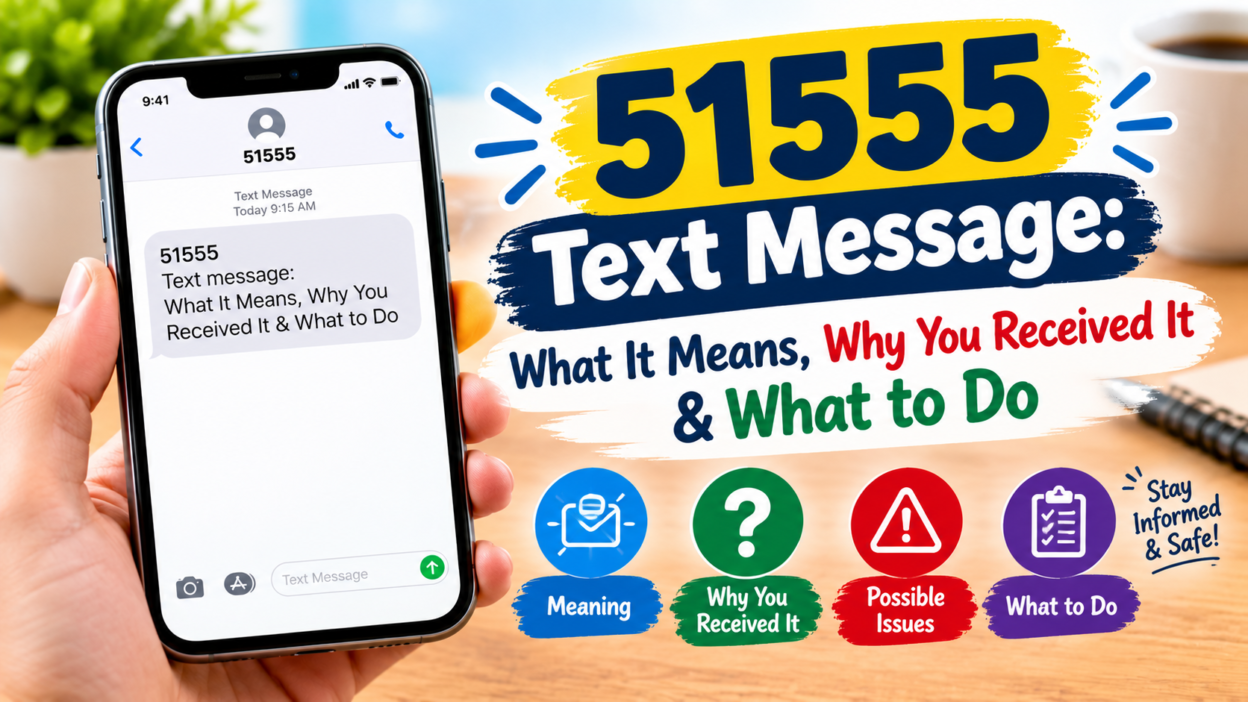
If you received a 51555 text message, you may be wondering who sent it, why it appeared on your phone, and whether you need to respond. The important thing to know is that 51555 is a five-digit SMS short code, not a normal personal phone number. It has been used by different organizations and messaging programs for alerts, subscriptions, fundraising, donations, community updates, and other text-based services.
That means there isn’t one universal message associated with 51555. The meaning depends on the organization behind the message and the keyword, service, or campaign connected to it.
For example, organizations have used 51555 for mobile alerts, volunteer information, job notifications, disaster alerts, donations, and advocacy updates. The Salvation Army has published several programs using 51555, while Operation Blessing currently lists 51555 for text donations.
So, if this number appeared in your messages, don’t assume that it automatically means spam. At the same time, you shouldn’t trust an unexpected message simply because it comes from a short code.
Here’s how to understand it safely.
What Is 51555 in a Text Message?
51555 is a SMS short code used for automated text messaging programs.
Unlike a regular phone number, which usually has seven or ten digits in the United States, a short code contains only a few digits. Businesses, charities, organizations, and other groups can use short codes to communicate with large numbers of subscribers.
The number itself doesn’t tell you exactly which organization sent your message. Instead, the surrounding message provides the important context.
For instance, one organization may tell people to text a keyword to 51555 to receive local alerts. Another may use the same short code for fundraising. A different campaign can use it for reminders or informational messages.
This is why searching only for the number may produce several different results.
Historical short-code records associate 51555 with MobileCause-related messaging programs, including charity alerts. Current and recent organizational pages also show 51555 being used for several unrelated messaging campaigns.
In simple terms, 51555 is best understood as a messaging destination rather than a person’s phone number.
Why Did I Get a 51555 Text Message?
There are several possible reasons.
The most common explanation is that your number became associated with a particular text-message campaign. You may have intentionally subscribed, entered your number during an event, responded to an invitation, or joined a service that uses SMS notifications.
Sometimes you may also receive a message after another person entered the wrong number.
Here are some common possibilities:
You Signed Up for Text Alerts
An organization may ask people to text a specific word to 51555 to receive updates.
For example, The Salvation Army lists keywords for events, volunteering, jobs, disaster alerts, and inspirational messages through 51555.
If you remember signing up for something similar, the message may simply be a legitimate subscription notification.
You Joined a Fundraising Program
Some nonprofits use 51555 for text-to-give campaigns.
Operation Blessing, for example, currently tells supporters to text GiveOB to 51555 to make a donation.
Other organizations have also used the short code for fundraising and donation-related campaigns.
Therefore, if your message mentions a charity, donation, campaign, or giving opportunity, check the organization independently before taking action.
You Requested Information
A text subscription doesn’t always involve money.
Organizations have used 51555 to send educational information, community updates, event reminders, and other alerts. The University of Utah, for example, previously used 51555 as part of its Healthy for Good text program.
The same basic system can support many different types of communication.
Someone Entered Your Number by Mistake
It’s also possible that you didn’t personally sign up.
A person entering a phone number incorrectly can sometimes cause messages to reach someone else. That possibility becomes more relevant when the message refers to a person, organization, location, or service you don’t recognize.
In that situation, avoid assuming that the message was intentionally directed at you.
Is 51555 a Scam or Spam Number?
Not necessarily.
A short code can be used by legitimate organizations, but the existence of a short code doesn’t prove that every message you receive from it is trustworthy.
That distinction matters.
Search results show legitimate organizations using 51555 for donations, alerts, community programs, and subscriptions. At the same time, caller-identification services may receive reports or classifications for messages associated with short codes, so an unfamiliar message still deserves caution.
The safest approach is to evaluate the content of the message, not just the five-digit number.
Look for signs such as:
- A recognizable organization name
- A service you actually joined
- A message you were expecting
- Clear subscription information
- Normal instructions for managing the subscription
- No suspicious demand for sensitive information
Be more cautious if the message:
- Claims you’ve won an unexpected prize
- Demands immediate payment
- Requests passwords or verification codes
- Asks for banking credentials
- Uses threatening language
- Contains an unfamiliar payment request
- Creates unnecessary urgency
- Tells you to bypass normal security procedures
A legitimate short code can be used for helpful services. However, you should still verify unexpected requests independently.
Does 51555 Belong to One Company?
No single organization should be assumed to own every message associated with 51555.
This is one of the biggest misunderstandings about short codes.
Several organizations have publicly documented their use of the same short code. For example, different Salvation Army locations use 51555 for their own local alert programs, including event, volunteer, job, and disaster notifications.
Other organizations have used it for completely different purposes.
Operation Blessing uses it for text donations, while the Ohio State Medical Association has used it for advocacy-related text alerts.
As a result, the number alone isn’t enough to identify the sender.
The exact wording of your message is much more useful.
What Does a 51555 Message Usually Contain?
The content can vary considerably.
A typical message may include the organization name, the purpose of the subscription, instructions, or a keyword associated with the campaign.
For example, a community alert might tell you that you have subscribed to notifications. A fundraising campaign could provide instructions for donating. An employment service might send job-related updates.
Some programs also provide standard commands.
A legitimate subscription may tell users to reply STOP to unsubscribe or HELP for assistance. Several organizations using 51555 publicly provide those instructions.
However, don’t rely solely on a generic command when the message itself looks suspicious. If you’re uncertain, verify the organization through a trusted website or contact method rather than following an unfamiliar request.
Can You Reply STOP to 51555?
In many documented 51555 programs, STOP is used to unsubscribe from messages.
For example, Salvation Army pages using 51555 instruct subscribers to text STOP to the short code to stop receiving messages. A historical listing for a MobileCause campaign also provides STOP as the unsubscribe instruction.
However, context still matters.
If you recognize the organization and the message clearly identifies the subscription, following its stated unsubscribe instructions is reasonable.
If the message appears fraudulent, you may prefer to avoid interacting with it until you’ve verified the sender. Depending on your phone and carrier, you may also have options to block or report unwanted messages.
Don’t send sensitive information in response to an unexpected text.
How to Find Out Who Sent a 51555 Text
Start with the message itself.
Read the entire text instead of focusing only on the number. Look for:
- The organization name.
- The reason for the message.
- Any keyword you may have used.
- Subscription or campaign information.
- Contact instructions.
- Unsubscribe instructions.
- Any transaction or donation information.
Next, think about what you recently did.
Did you sign up for local alerts? Did you attend a charity event? Did you request information from an organization? Did you donate to a nonprofit? Did you register for community updates?
Those details can help connect the message with its source.
You can also search for the organization separately. If the message claims to come from a charity, for example, find that charity’s official website yourself rather than relying on a link inside an unexpected text.
This extra step is especially useful when money or account information is involved.
What If You Don’t Recognize the Message?
Don’t panic.
An unfamiliar text doesn’t automatically mean your phone has been hacked.
First, identify what the message actually says. A short code can serve many different campaigns, so an unexplained message may simply result from an old subscription, a mistaken phone number, or an organization you don’t immediately recognize.
If the message contains no request for sensitive information, you can investigate the sender before taking action.
On the other hand, if it asks you to provide passwords, financial information, security codes, or other sensitive details, stop and verify the request through an independent channel.
For example, if a message claims to represent a bank, don’t use the contact information provided in the text. Instead, use the bank’s official app, website, or a trusted phone number.
That small habit can prevent many avoidable problems.
51555 Text Messages and Donations
One important use of 51555 is text-based fundraising.
Text-to-give systems allow organizations to promote donations through a short code. A person may be instructed to send a keyword to the number and then follow additional instructions.
Operation Blessing currently advertises a text-to-give option using 51555. The Joubert Syndrome & Related Disorders Foundation also previously used 51555 as part of a text-message fundraising and awareness program.
However, receiving a donation-related message doesn’t mean you have to donate.
Before making a payment, verify:
- The organization exists.
- The campaign is listed through an official source.
- The donation instructions match the organization’s published information.
- You understand what you’re being charged.
- You’re comfortable with the transaction.
If something feels inconsistent, stop before providing payment information.
51555 for Alerts and Community Updates
Another major use is information and alert subscriptions.
Organizations can use SMS to send updates about events, volunteer opportunities, jobs, disasters, and community activities.
The Salvation Army provides several examples. Its local pages list 51555 for event and fundraising alerts, volunteer opportunities, job alerts, disaster information, and Sunday inspirational messages.
Community organizations can use a similar system.
For example, Bangor Housing published instructions for residents to text a keyword to 51555 for community events, storm alerts, and emergency notices.
Therefore, a 51555 message may have nothing to do with advertising or personal communication. It could simply be an automated notification service.
Can 51555 Be Used for Different Keywords?
Yes.
This is another reason the number alone doesn’t reveal the exact service.
Different campaigns can assign different keywords to the same short code.
For example, Salvation Army locations have published keywords such as AURORA, MIDWAY, VOLUNTEER, SAJOBS, and BLESSED for different types of alerts sent through 51555.
Other organizations use their own keywords for their own programs.
This setup allows the same short code to support multiple campaigns while the keyword determines the service a subscriber wants.
Consequently, if your message mentions a particular keyword, that word can be more informative than the number itself.
What Should You Do After Receiving 51555?
Your next step depends on the message.
If you recognize the organization and expected the message, you can follow its instructions.
If you don’t recognize it, investigate before responding.
If you no longer want legitimate alerts, use the unsubscribe instructions provided by the service. Many documented 51555 programs specifically direct subscribers to use STOP.
If the message looks suspicious, don’t provide personal or financial information.
You can also use your phone’s blocking or spam-reporting features when appropriate.
Most importantly, don’t let an urgent-looking message pressure you into making a quick decision.
Common Mistakes People Make With 51555
A few misunderstandings come up repeatedly.
Assuming 51555 Has One Fixed Meaning
It doesn’t.
Different organizations can use the same short code for different campaigns.
Treating Every Short Code as Safe
A five-digit number doesn’t automatically guarantee that every message is legitimate.
Look at the message content and verify unexpected requests.
Treating Every Unexpected Message as a Scam
That can also be misleading.
You might have forgotten about an old subscription, or someone may have entered your number accidentally.
Sending Personal Information
Never provide sensitive information simply because a text asks for it.
Verify the request independently first.
Clicking Before Reading
Take a moment to understand why you’re receiving the message. If the text includes a suspicious link or an urgent financial request, verify the organization separately.
How 51555 Differs From a Normal Phone Number
A normal mobile number usually identifies a person, business line, or specific telephone account.
A short code works differently.
It is designed for automated messaging programs and can support large-scale communication. That’s why organizations can use a five-digit number to distribute alerts or manage subscriptions.
The difference also explains why you may not be able to call 51555 like an ordinary phone number.
In many cases, the service expects you to interact through SMS commands rather than a traditional voice call.
So if you see 51555 in your text history, think automated messaging service, not necessarily individual sender.
Is It Safe to Text 51555?
The answer depends on what you’re trying to do.
If a trusted organization publicly tells you to send a particular keyword to 51555, that can be a normal way to join its messaging program.
For example, several established organizations publicly publish their 51555 instructions.
However, don’t assume that an instruction is trustworthy merely because it uses a short code.
If someone sends you a message telling you to text a keyword, verify that instruction through the organization’s official communication channels first.
This is particularly important when the text involves money, prizes, account access, or sensitive information.
51555 Text Message: Key Things to Remember
The most important point is simple: 51555 doesn’t have one universal meaning.
It is a short code that has been used by different organizations and messaging campaigns.
Depending on the program, a 51555 text may relate to:
- Community alerts
- Charity fundraising
- Donations
- Volunteer opportunities
- Job notifications
- Disaster alerts
- Educational information
- Event reminders
- Advocacy alerts
- Other SMS subscriptions
Documented examples confirm that organizations use 51555 for several unrelated purposes.
Therefore, the best way to identify your particular message is to examine its wording, identify the organization mentioned, and verify the information independently when necessary.
If you recognize the service, follow its published instructions. If you don’t recognize it, investigate before responding. And if the message requests sensitive information or money unexpectedly, take extra care.
Frequently Asked Questions About 51555 Text Messages
What is a 51555 text message?
A 51555 text message comes from a five-digit SMS short code. Different organizations have used this short code for alerts, donations, fundraising, community information, and other messaging services.
Is 51555 a real phone number?
51555 is an SMS short code rather than a standard personal telephone number. Short codes are commonly used for automated text-message programs.
Who uses 51555?
There isn’t one single sender. Publicly documented examples include nonprofit organizations, community programs, and other organizations using the number for different messaging campaigns.
Why did I receive a message from 51555?
You may have subscribed to a text service, interacted with an organization, participated in a campaign, or had your number entered accidentally. Check the message content for clues about the specific program.
Can I stop 51555 messages?
Many documented programs using 51555 provide STOP as an unsubscribe command. For example, several Salvation Army programs explicitly tell subscribers to text STOP to 51555.
Is a 51555 message automatically safe?
No. The short code itself shouldn’t be treated as proof that every message is legitimate. Check the organization and the request before sharing information or making payments.
Can 51555 be used for donations?
Yes. Organizations have used 51555 for text-to-give campaigns. Operation Blessing currently publishes instructions for donating by texting GiveOB to 51555.
Should I reply to an unexpected 51555 message?
First determine who sent it and why. If the message is unfamiliar, avoid sharing sensitive information or following suspicious instructions until you’ve independently verified the organization.
Conclusion
A 51555 text message is generally associated with an SMS short-code service rather than one specific person or company. The same five-digit number has been used by different organizations for alerts, donations, fundraising, community updates, volunteer information, job notifications, and other campaigns. Because of that, the number alone can’t tell you exactly why you received a message. Read the full text, identify the organization or campaign, and verify unexpected requests before responding. If it’s a legitimate subscription you no longer want, follow the service’s published unsubscribe instructions. When money, passwords, security codes, or other sensitive information are involved, take extra time to verify the request independently.