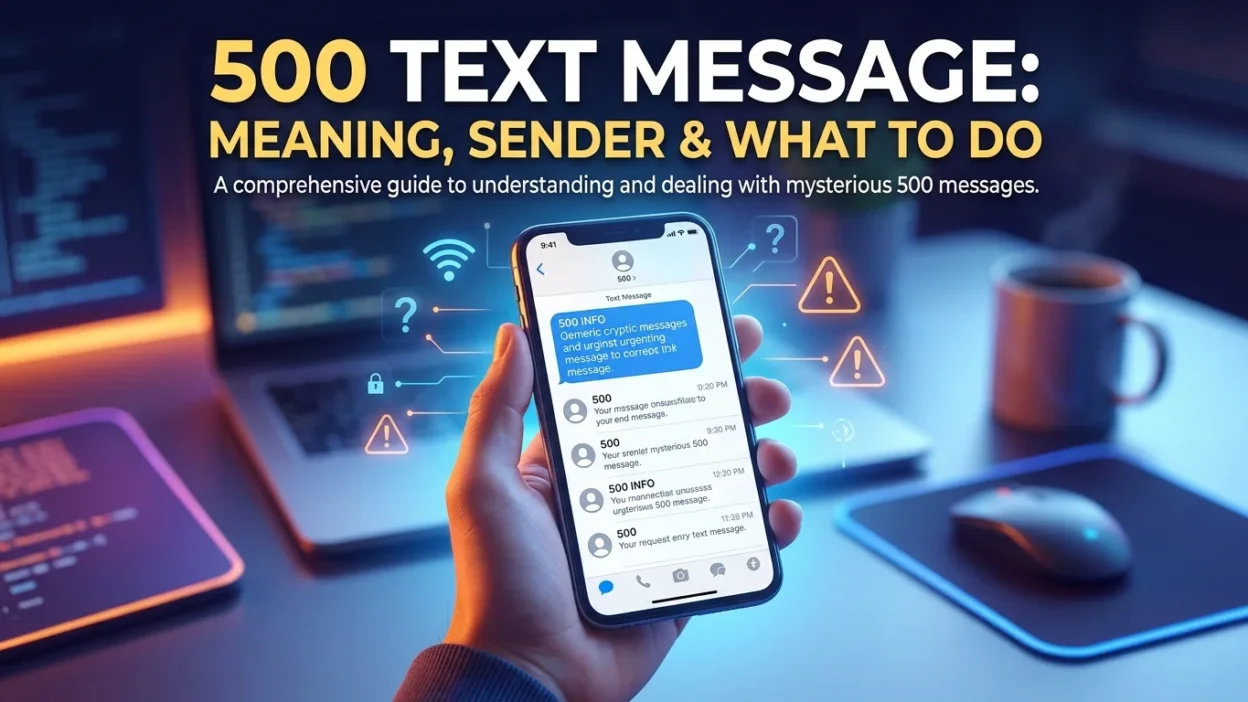
Receiving a 500 text message or seeing “500” connected with your mobile account can be confusing. At first glance, it may look like an ordinary phone number, a secret texting code, or even a suspicious message. However, the meaning depends heavily on where you saw 500 and what appeared around it.
In some situations, 500 may appear as a sender ID or short code. In other cases, especially in mobile-account records, it may represent a network or messaging identifier rather than a normal person-to-person text number. Short codes generally contain fewer digits than standard phone numbers and can be used for automated messages, alerts, authentication, and other services.
This guide explains the most likely meanings of 500, how to identify the context, what to do if you received a message, and when you should treat it as suspicious.
🔎 What Does 500 Mean in a Text Message?
The meaning of 500 isn’t universal. A three-digit number by itself doesn’t provide enough information to identify the sender or purpose with certainty.
For example, 500 can appear in different situations:
- As a short sender ID
- In a carrier’s usage or messaging records
- As part of a service-generated message
- As a number associated with an automated system
- As a reference connected to a particular telecom service
- As a quantity, such as 500 available or used messages
Therefore, don’t assume that every appearance of “500” refers to the same service.
The surrounding information matters most. Check whether 500 appears inside your normal messaging app, on your phone bill, in a carrier account, or in another service.
One source specifically associates the “500 text message” search term with messaging activity recorded in T-Mobile-related account records and describes it as an internal system identifier rather than an ordinary number you would dial. That interpretation is context-specific, so it shouldn’t automatically be applied to every 500 message worldwide.
📱 Is 500 a Regular Phone Number?
No, 500 by itself isn’t a typical personal mobile number.
- A conventional phone number usually contains substantially more digits, although the exact format differs by country. A three-digit sender can instead function as a short code or service identifier.
- SMS short codes are designed to be shorter than ordinary telephone numbers. They commonly support automated communication such as notifications, marketing messages, authentication, and other high-volume messaging services.
- That distinction is important.
- If you see a message from a three-digit sender, you shouldn’t immediately assume that an individual person typed and sent it manually. Automated systems can generate messages using shortened sender identifiers.
At the same time, the number alone doesn’t prove that a message is legitimate. You still need to consider its content and the circumstances in which you received it.
💬 Why Might You Receive a 500 Text Message?
There are several possible reasons.
First, your mobile carrier or another messaging system may use a short identifier for automated communication. Such systems can send alerts without displaying a conventional phone number.
- Second, 500 may appear in an account’s usage information rather than your actual inbox. In that situation, the number may represent a system-level messaging reference instead of a conversation with another person.
- Third, a business or service may use a short code for automated communication. Short codes are commonly used for notifications, promotions, verification messages, and similar services.
- Finally, the number could simply be part of a larger reference or message count.
For that reason, the message itself is more useful than the number alone. Read the full text, check the sender details, and consider what service you were using around the time it arrived.
🧾 500 Text Message on a Phone Bill or Usage Record
This is one of the most important situations to understand.
If you didn’t receive a normal conversation but noticed 500 in your carrier’s detailed usage history, don’t assume that someone sent you a message from a mysterious three-digit phone number.
Carrier systems can record messaging activity using technical identifiers. Those identifiers may not correspond directly to the number you would see when communicating with a friend.
A search result specifically discussing T-Mobile describes 500 as an internal system identifier associated with certain messaging activity in account records. The source also distinguishes it from a normal number found in a standard texting application.
Still, carrier systems can change, and the meaning may depend on the account, network, service, or billing record.
If the entry concerns you, compare:
- The date and time
- The message type
- Incoming versus outgoing activity
- The associated service
- Any nearby entries in the usage record
- Your actual messages from that period
This approach is more reliable than interpreting “500” in isolation.
🛡️ Is a 500 Text Message Safe?
A 500 text message isn’t automatically dangerous or safe.
The sender number alone can’t establish whether a message is trustworthy. Instead, examine what the message asks you to do.
A routine notification might simply provide information. By contrast, a suspicious message may pressure you to click a link, provide sensitive information, send money, or reveal a verification code.
Be especially careful if the message:
- Creates a sense of urgency
- Requests a password
- Requests a verification code
- Asks for banking information
- Demands payment
- Tells you to install unknown software
- Uses threatening language
- Includes an unexpected link
- Claims your account will immediately be closed
A legitimate-looking sender ID doesn’t guarantee legitimacy.
Scammers can use automated messaging techniques, while legitimate organizations can also use short codes. Therefore, judge the content and context, not merely the number.
🚨 What Should You Do If 500 Sends You a Suspicious Text?
If the message looks unusual, don’t rush to respond.
Start by reading it carefully. Don’t click anything simply because the message claims that an account problem needs immediate attention.
- If the message mentions a company, bank, delivery service, social platform, or mobile carrier, verify the claim through that organization’s official app or website. Use contact information you already trust rather than information contained in the suspicious message.
- For example, if a message says your bank account needs verification, open your banking app independently. If there is a genuine problem, you can usually find information there.
- Likewise, if a message claims to come from your carrier, check your carrier account directly.
- This simple habit reduces the chance of following a fraudulent instruction.
🔐 Should You Reply to 500?
There’s no universal reason to reply to every message associated with 500.
If the message is clearly an automated notification and doesn’t require a response, you may simply leave it alone.
If it asks you to reply with personal information, stop and verify the request first.
Don’t send passwords, payment details, security codes, or other sensitive information through an unexpected text conversation.
In addition, don’t reply to a suspicious message merely to ask whether it’s real. Responding can sometimes confirm that your number is active, depending on how the sender operates.
When in doubt, verify the organization through a separate trusted channel.
📲 500 as a Short Code vs. 500 in Account Records
These two situations can look similar, but they’re not necessarily the same.
A short code is a shortened numeric sender identifier used in SMS and MMS communication. Short codes commonly support automated services, including alerts and authentication.
- An account-record identifier, on the other hand, may describe how a carrier categorizes or logs messaging activity internally.
- This difference explains why one person might search for “500 text message” after seeing it in a usage history while another person might see a short sender in their messaging application.
- Therefore, always ask:
- Where did I see 500?
- If it appeared in your inbox, inspect the actual message.
- If it appeared on your bill, inspect the usage details.
- If it appeared inside another application, check that application’s messaging or notification information.
- The location often provides the first major clue.
👥 How Context Changes the Meaning of 500
Context can dramatically change how you should interpret a messaging number.
Imagine you’re checking your mobile bill and see 500 next to a messaging entry. That situation is different from receiving a text that says, “Your verification code is…” from a three-digit sender.
Similarly, seeing “500 messages remaining” in a messaging platform doesn’t mean you received a message from the number 500.
Consider these common contexts:
Texting app: 500 may be displayed as a sender or service identifier.
Carrier account: 500 may be associated with a technical or usage record.
Business platform: 500 could refer to a messaging allowance or campaign quantity.
Verification service: A short sender may deliver an automated security message.
Marketing service: A business may use a short code to communicate with subscribers.
Because these contexts differ, a single definition would be misleading.
⚠️ Common Mistakes People Make About 500 Text Messages
People often make the same assumptions when they encounter an unfamiliar messaging number.
Assuming 500 Is a Person
A three-digit sender doesn’t necessarily identify an individual. Short codes can belong to automated services.
Assuming Every 500 Message Is a Scam
An unfamiliar sender can certainly deserve caution. However, the number alone doesn’t prove malicious intent.
Assuming Every 500 Message Is Legitimate
The opposite assumption is equally risky. A familiar-looking or short sender doesn’t make every message trustworthy.
Ignoring the Message Content
The actual text often provides more information than the sender number.
Clicking Before Checking
If you’re unsure about a message, verify it independently before interacting with links or attachments.
Confusing Usage Records With Incoming Texts
A number appearing on a carrier bill may represent technical messaging activity rather than a person contacting you.
These distinctions can prevent unnecessary worry and reduce avoidable security risks.
🌎 Does 500 Mean the Same Thing Everywhere?
Not necessarily.
SMS systems vary by country, carrier, messaging provider, and service. A sender identifier that has one purpose in one market may have a different purpose elsewhere.
- For instance, databases that track SMS senders can associate the same numeric sender with different countries or routing information. That makes it especially important to avoid treating a three-digit sender as a universal code.
- Your carrier also matters.
- A message received on a U.S. mobile network may have a different explanation from a message received through a carrier in another country. Likewise, an entry on a business messaging platform may have nothing to do with your personal mobile account.
- Consequently, location and carrier context should be considered before drawing a conclusion.
💼 500 Text Message in Business and Automated Messaging
The number 500 can also appear in business messaging without being a sender number.
- Companies often purchase or use messaging credits to communicate with customers. Some services offer packages containing hundreds or thousands of messages.
- For example, business messaging platforms may describe plans in terms of 500 available messages or credits. In that case, “500” refers to a quantity rather than a sender identity.
- This distinction is easy to overlook.
- If you see something like “500 messages,” “500 credits,” or “500 texts remaining,” you’re probably looking at a usage allowance.
- If you see only “500” as the sender of an incoming message, you’re dealing with a different situation.
- Always read the surrounding words before interpreting the number.
🧠 Can 500 Be a Texting Abbreviation?
Usually, 500 isn’t a standard texting abbreviation with one universally accepted meaning.
- Common texting abbreviations such as “LOL,” “BRB,” or “IDK” represent language shortcuts. A numeric sender such as 500 is different because it may identify a service, system, or messaging route.
- Therefore, searching for a dictionary-style definition of “500” can be misleading.
- The better question is:
- Where did 500 appear, and what was happening at the time?
- That question helps separate slang from technical messaging information.
🔍 How to Identify an Unknown 500 Text
You can investigate the message without taking unnecessary risks.
Start with the sender information. Look at whether your phone displays 500 alone or provides additional sender details.
Next, read the message without clicking any links.
Then consider whether you recently:
- Created an account
- Requested a verification code
- Contacted customer support
- Made an online purchase
- Changed a mobile service
- Subscribed to notifications
- Requested a password reset
- Used a business or delivery service
If one of these events matches the timing, the message may be related to that activity.
However, don’t treat a matching event as proof. If the message requests sensitive information, verify it independently.
📌 What If You Never Requested the Message?
An unexpected message doesn’t automatically mean your phone has been hacked.
You might have received it because someone entered your number incorrectly. An automated system might also have sent a notification after an action involving your number.
For example, someone could accidentally enter your phone number while attempting to create or recover an account.
Still, unexpected security codes deserve attention.
If you receive a verification code that you didn’t request, don’t share it with anyone. Instead, check whether the associated account has any unusual activity.
If the messages continue, consider contacting the relevant service or your mobile provider through an official support channel.
👨💻 500 Text Message and Online Account Security
Text messages are frequently used as part of account verification, so unexpected codes should be handled carefully.
Suppose you suddenly receive a message containing a six-digit verification code. You didn’t request it, and someone then contacts you asking for that code.
Don’t provide it.
The person may be attempting to use the code to access an account. The safest approach is to keep the code private and investigate the unexpected activity through the service’s official account interface.
Furthermore, avoid assuming that the sender’s short number proves the request is genuine.
Security depends on the entire communication, not simply the sender ID.
💡 Expert Tips for Handling an Unknown Messaging Code
A few simple habits can make unfamiliar text messages much easier to manage.
- Check the context first. Ask where the message came from and whether you recently performed a related action.
- Don’t act under pressure. Urgent language is a common reason people make unsafe decisions.
- Protect verification codes. Never give an unexpected security code to another person.
- Verify independently. Use the official application or website of the organization mentioned.
- Review account activity. If the message concerns an account, check recent sign-ins, orders, payments, or security settings.
- Contact your carrier when necessary. If 500 appears repeatedly in your billing or usage records and you can’t identify it, carrier support can explain the entry more accurately.
These steps are simple, but they help separate ordinary automated communication from genuinely concerning activity.
❓ Frequently Asked Questions About 500 Text Message
What is a 500 text message?
A 500 text message can refer to different things depending on where you see it. It may be a short sender identifier, a carrier-related messaging record, or a reference to a quantity of messages. The surrounding context determines the likely meaning.
Is 500 a real phone number?
500 by itself isn’t a typical personal phone number. It can function as a short numeric sender or identifier in some messaging systems. However, its exact purpose depends on the country, carrier, and service involved.
Is a message from 500 a scam?
Not necessarily. A message from a short sender can come from an automated or legitimate service. However, you should still inspect the content and avoid clicking unexpected links or sharing sensitive information.
Why do I see 500 on my phone bill?
If 500 appears in your carrier usage records, it may represent a messaging or system identifier rather than a normal incoming text from an individual. The exact interpretation depends on your carrier and the details of the entry.
Should I reply to a message from 500?
Only reply when you understand who sent the message and why. If the message is unexpected or requests sensitive information, verify the request through an independent official channel first.
Can 500 be used for automated texts?
Yes, short numeric sender IDs can be used for automated messaging services. Short codes are commonly used for notifications, authentication, marketing, and other automated communications.
What should I do if 500 keeps texting me?
Review the content and determine whether it connects to a service you use. Don’t click suspicious links or provide private information. If the messages continue and you cannot identify the source, contact your carrier or the relevant service through an official channel.
Does 500 have one universal meaning?
No. There isn’t one meaning that applies to every appearance of 500. The carrier, country, platform, message content, and location where you saw the number can all affect its interpretation.
📝 Conclusion
A 500 text message can be confusing because the number doesn’t have one universal meaning. Depending on the situation, it may appear as a short sender identifier, a carrier-related messaging record, an automated service reference, or simply part of a message allowance. The safest approach is to look at the complete context rather than guessing from the number alone. If the message requests sensitive information, payment, a verification code, or an unexpected action, pause and verify the request independently. By checking the sender, message content, timing, and carrier records, you can usually determine whether the message is ordinary, technical, or worth further investigation.