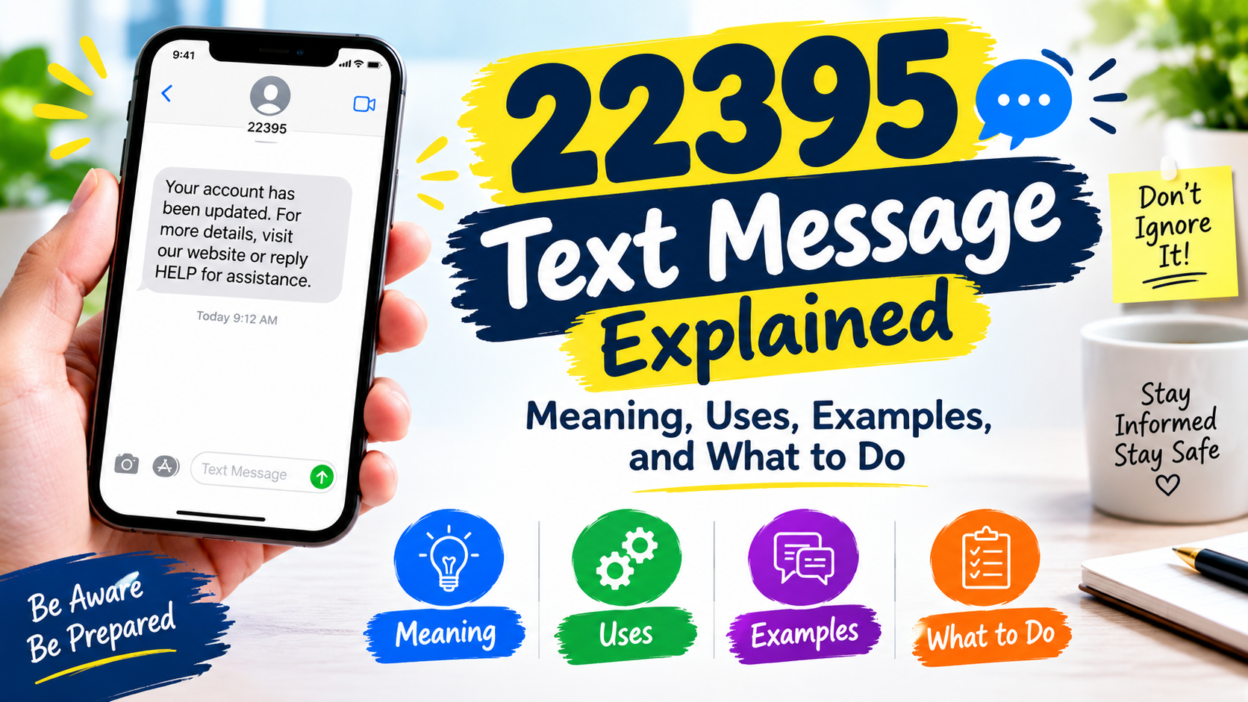
If you received a 22395 text message, the five-digit sender may look unfamiliar, but the number itself does not automatically mean you’re dealing with spam. Current evidence shows that 22395 can function as a shared SMS short code for verification and other automated messages. Twilio has published an example using 22395 for an OTP verification message, while Gemini lists 22395 as one of its legitimate SMS verification short codes.
The important point is that a 22395 text message does not identify one single company in every situation. Shared short codes can carry messages for different services. Therefore, the safest way to understand a message is to read its wording, identify the service named in it, and consider whether you actually requested the action.
This guide explains what 22395 means, why you may receive a message from it, how verification codes work, what an unexpected message could indicate, and how to respond without putting your account at risk.
🔎 What Is a 22395 Text Message?
A 22395 text message is an SMS sent from the five-digit short code 22395. Short codes are commonly used for automated communications because they are easier for businesses and messaging providers to use at scale than ordinary phone numbers.
The number itself is best viewed as a messaging channel, rather than proof that one specific company contacted you. Current sources associate 22395 with authentication and verification traffic. For example, Twilio has demonstrated its Verify service sending an OTP from 22395.
Gemini also identifies 22395 as a legitimate short code for certain one-time phone-verification messages.
So, when a 22395 text message appears, don’t judge it solely by the sender number. Instead, check the complete message.
A typical message may contain:
- A one-time verification code
- The name of a service
- A sign-in or phone-verification request
- Instructions to enter the code
- Security information
- Occasionally, a link or other action request
That distinction matters because a legitimate short code can still be used in a message that you did not request.
📱 Why Did I Get a 22395 Text Message?
There are several reasonable explanations for receiving a 22395 text message.
The most straightforward explanation is that you recently requested a verification code. You may have logged into an account, registered a phone number, confirmed a device, or completed another security step.
Another possibility is that someone entered your phone number while attempting to access or register an account. An unexpected verification code does not automatically prove that someone successfully accessed your account. The code may have been generated because another person entered your number during a login or registration attempt.
A third possibility is a simple typing mistake. Someone could have entered your phone number instead of their own.
Finally, the message could be suspicious if it contains unusual instructions, especially if it asks you to reveal a security code or contact an unfamiliar number.
Common reasons at a glance
SituationWhat it may meanYou requested a codeNormal verificationYou recently created an accountPhone-number confirmationYou tried to log inTwo-factor authenticationYou did nothingSomeone may have entered your numberYou received repeated codesRepeated login or verification attemptsMessage asks for your OTPPotential social-engineering attemptMessage contains an unfamiliar payment requestVerify independently
Therefore, the context surrounding the 22395 text message matters more than the five-digit number alone.
🔐 Is 22395 a Verification Code Number?
Yes, there is strong evidence connecting 22395 with verification-code delivery.
Twilio’s own material includes a Verify example in which an OTP is sent from the short code 22395.
Gemini independently lists 22395 among the short codes it uses for SMS phone-number verification. Gemini also tells users to enter verification codes only through the official Gemini app or Gemini.com.
This means that a 22395 text message containing a one-time code can be completely legitimate when it matches an action you just initiated.
However, legitimate delivery does not mean you should automatically trust every instruction contained in a message.
Think of the short code as the delivery route. The message content tells you what service generated the request and what action, if any, you should take.
🧾 What Does a Typical 22395 Message Look Like?
The exact wording varies according to the service sending the SMS.
A normal verification message might look conceptually like this:
“Your verification code is 123456. Enter this code to verify your phone.”
The actual wording and code will vary. You should never use a sample code from an article as though it were your own.
A legitimate 22395 text message may also mention the service that requested verification. That detail can help you decide whether the message matches something you were doing.
For example, suppose you just opened an account and the website displayed a message asking you to verify your phone. Seconds later, a code arrives from 22395. The timing and context make the message easier to understand.
By contrast, if you were not logging in, registering, changing a password, or confirming a phone number, pause before taking action.
⚠️ Is a 22395 Text Message a Scam?
Not necessarily.
The evidence does not support treating every 22395 text message as a scam. Twilio has documented 22395 in an OTP verification example, and Gemini identifies it as an official short code for certain verification texts.
At the same time, scammers can exploit genuine verification systems. They may attempt to convince you to share an OTP that was legitimately generated.
This creates an important distinction:
A real verification code can become part of a scam when someone tricks you into giving that code to them.
For example, a scammer may claim to be from customer support and say:
“We accidentally sent a code to your phone. Please read it back.”
Don’t do that.
A one-time code is designed to prove control of your phone number or authorize an action. Giving it to another person can undermine that security step.
🚨 What If You Didn’t Request the 22395 Code?
An unexpected 22395 text message deserves attention, but it doesn’t automatically mean your account has been hacked.
First, consider whether you recently performed an action that could have triggered the code. Sometimes people forget that they requested verification a few minutes earlier.
If you definitely did not request it, don’t enter the code anywhere unless you independently confirm why it was generated.
Also, don’t forward the code to anyone.
You can safely leave an unsolicited verification message alone while you investigate. If you are concerned about a particular account, open its official website or app yourself rather than using a link from the unexpected message.
This approach removes much of the pressure that scammers try to create.
🛡️ How to Handle an Unexpected 22395 Text Message
When a 22395 text message arrives unexpectedly, use a simple verification process.
1. Read the entire message
Don’t focus only on the code. Look for the company or service name, reason for verification, and requested action.
2. Ask whether you initiated anything
Did you just sign in? Did you create an account? Were you adding a phone number? Did you request a password reset?
If yes, the message may be connected to that activity.
3. Never share the OTP
A verification code should remain private. Don’t send it to a friend, stranger, supposed employee, or person claiming to be technical support.
4. Avoid suspicious links
If the message contains a link and you weren’t expecting it, don’t click it simply because the sender appears to be a familiar short code.
Instead, open the official app or type the company’s known website address yourself.
5. Check the account independently
If you suspect someone attempted to access your account, sign in through the official service and review recent activity, security settings, and connected devices where available.
6. Contact the company through an official channel
Use contact information obtained from the company’s official website or app. Don’t rely on an unfamiliar phone number supplied in a suspicious SMS.
These steps are especially important because the same short code may support more than one messaging use.
🏦 What If the 22395 Text Mentions a Bank or Payment?
Be particularly careful if a 22395 text message mentions money, a wire transfer, a purchase, a card transaction, or an account problem.
An older publicly reported example involved a message claiming to be a Bank of America transaction alert and directing the recipient to a phone number. The recipient reported it as fraudulent because the account and contact details did not match their situation.
That example illustrates an important lesson: the appearance of a verification code doesn’t prove the entire message is legitimate.
If a message claims that money is moving:
- Don’t call a number supplied by the suspicious message.
- Don’t share the verification code.
- Open your bank’s official app.
- Check your transactions directly.
- Contact the bank using its verified customer-service channel.
This method lets you investigate the claim without relying on potentially manipulated instructions.
💬 Can 22395 Be Used by Different Services?
Yes. This is one of the most important details to understand.
Current search results describe 22395 as a shared short code, and multiple services have documented legitimate uses for it. For example, Gemini lists 22395 for SMS phone verification, while Twilio has shown 22395 in a Verify OTP example.
That means searching only for “Who owns 22395?” may not give you a complete answer.
Instead, ask:
“What service does this particular message mention?”
The message body can provide more useful context than the number itself.
This also explains why two people could receive messages from 22395 that look completely different.
🧠 22395 Text Message vs. Ordinary Phone Number
A five-digit short code differs from a normal mobile phone number.
FeatureShort codeOrdinary phone numberLengthUsually much shorterUsually full-lengthCommon useAutomated SMSCalls and personal/business textingTypical purposeAlerts, OTPs, notificationsDirect communicationHuman conversationLess commonCommonAuthenticationFrequently usedAlso possibleIdentificationMay represent a messaging serviceOften tied to a specific number
Therefore, seeing only five digits doesn’t tell you whether a message is safe.
The content and context still matter.
👥 Why Would a Company Use a Short Code?
Businesses and technology services use short codes because automated SMS can support high-volume communication.
A verification system, for instance, may need to send thousands of one-time codes quickly. Short-code messaging provides a recognizable channel for that type of communication.
The user experience is also simple. A person enters a phone number, receives a code, and enters it into the service that requested verification.
From a security perspective, the OTP provides an additional authentication factor. It can help a service confirm that the person completing an action has access to the registered phone.
However, SMS verification isn’t a reason to share the code with another person. The code is useful precisely because it is supposed to remain under the control of the intended user.
❌ Common Mistakes People Make With 22395
Several mistakes can turn a harmless verification message into a security problem.
Sharing the code
This is the biggest mistake. Someone who asks you to read a verification code may be trying to use it themselves.
Assuming the number guarantees legitimacy
A recognizable short code isn’t enough. Evaluate the entire message.
Clicking without checking
If you weren’t expecting a message, avoid clicking its links until you’ve verified the source.
Calling a number from the SMS
A suspicious message can provide a fake support number. Find the company’s contact details independently.
Panicking over one unexpected code
An isolated code can result from a typing mistake or an attempted registration. Don’t assume the worst without evidence.
Ignoring repeated unexpected codes
Repeated messages deserve more attention. They may indicate repeated attempts to trigger authentication requests for your number.
🧩 What If Someone Asks You for the 22395 Code?
Don’t provide it.
The safest response is no response.
A legitimate company may send a code for you to enter into its own official login or verification screen. That is different from an employee, stranger, buyer, seller, friend, or supposed support agent asking you to send the code to them.
Gemini explicitly warns users about requests for passwords and OTPs and advises entering codes only through its official channels.
If somebody says, “I need the code to verify your identity,” stop and verify the request independently.
You don’t need to prove anything by giving away a private authentication code.
🌐 Does the Meaning Change by Platform?
It can.
A 22395 text message connected to one service may be a phone-verification code, while another message using the same short code may relate to a different automated process.
That’s why platform context matters.
For example:
- A cryptocurrency platform may send a phone-verification code.
- A shopping service may request checkout verification.
- An authentication provider may deliver an OTP.
- Another service may use the same messaging infrastructure for security alerts.
The exact meaning should come from the message content and the service named in it, not from assumptions about the number.
This is also why old online lookup pages can sometimes provide incomplete answers. Short-code assignments and messaging arrangements can change over time.
🔍 How to Verify a 22395 Text Message Safely
If you’re unsure about a 22395 text message, use this checklist:
Step 1: Identify the service named in the SMS.
Step 2: Ask whether you recently requested a login, registration, verification, or transaction.
Step 3: Never share the code with another person.
Step 4: Don’t click unexpected links.
Step 5: Open the official app or website independently.
Step 6: Review account activity if you suspect an unauthorized login.
Step 7: Contact official support if the situation remains unclear.
Step 8: Change your password if you discover suspicious account activity.
Step 9: Enable stronger account security options when available.
The goal isn’t to determine whether the five-digit number “looks real.” The goal is to verify the action associated with the message.
🧪 Realistic Examples of 22395 Messages
Here are several situations that show how context changes the interpretation.
Example 1: You requested a login code
You open a service’s official app and request SMS verification. A code arrives from 22395.
Likely interpretation: Normal authentication.
Enter the code only into the official screen that requested it.
Example 2: You receive a code while doing nothing
You are watching a video when a verification code suddenly arrives.
Possible interpretation: Someone may have entered your number, or someone may have made a simple mistake.
Don’t share the code. If the messages continue, investigate the relevant account.
Example 3: Someone calls immediately
You receive a 22395 text message, and a stranger calls saying they’re support and need the code.
Interpretation: Treat this as a serious warning sign.
Don’t disclose the code. Verify the account independently.
Example 4: The SMS claims you sent money
The message says a transaction is waiting for approval.
Interpretation: Don’t use the phone number or link provided by the SMS until you’ve independently verified the claim.
Check the official financial account directly.
❓ Frequently Asked Questions About 22395 Text Messages
Is 22395 a legitimate short code?
Yes, 22395 has documented legitimate uses. Twilio has published an OTP example using the short code, and Gemini lists it as an official SMS verification number for certain account-verification messages.
Does every 22395 text message come from the same company?
No. The number can function as a shared messaging channel, so the service named in the message matters more than the short code by itself.
What should I do if I didn’t request a 22395 verification code?
Don’t share or enter the code unless you can connect it to an action you initiated. If you’re concerned, access the relevant account through its official app or website and review its security activity.
Can a 22395 message be part of a scam?
Yes, even when the underlying SMS delivery system is legitimate. A scammer may try to persuade you to reveal a genuine verification code or follow a malicious instruction.
Should I reply STOP to 22395?
Don’t automatically reply to an unexpected message simply because an online page suggests it. First identify the service and determine why you received the SMS. If you knowingly subscribed to a legitimate messaging program, follow that service’s official opt-out instructions.
Is 22395 connected to two-factor authentication?
It can be. Twilio has documented 22395 in an SMS OTP verification example, and other services use the short code for authentication-related messages.
What if someone asks me to send them the 22395 code?
Don’t send it. A verification code is intended for the authentication process that requested it. Anyone asking you to disclose it should be treated cautiously.
Does receiving a 22395 code mean my account was hacked?
Not necessarily. It could result from a legitimate request you forgot about, another person entering your number by mistake, or an attempted login or registration. Repeated or suspicious activity deserves further investigation.
🛡️ Final Takeaway
A 22395 text message is not automatically a scam, nor does the short code alone identify one company. Current evidence confirms legitimate authentication uses for 22395, including Twilio’s Verify examples and Gemini’s published verification information.
The safest approach is simple: read the message carefully, consider whether you initiated the action, never share an OTP, and verify important requests through the company’s official app or website.
If you requested the verification, use the code where the legitimate service asks for it. If you didn’t request it, don’t panic—but don’t ignore repeated or suspicious activity either. By focusing on the context rather than trusting the five-digit sender alone, you can handle an unfamiliar SMS more safely and confidently.