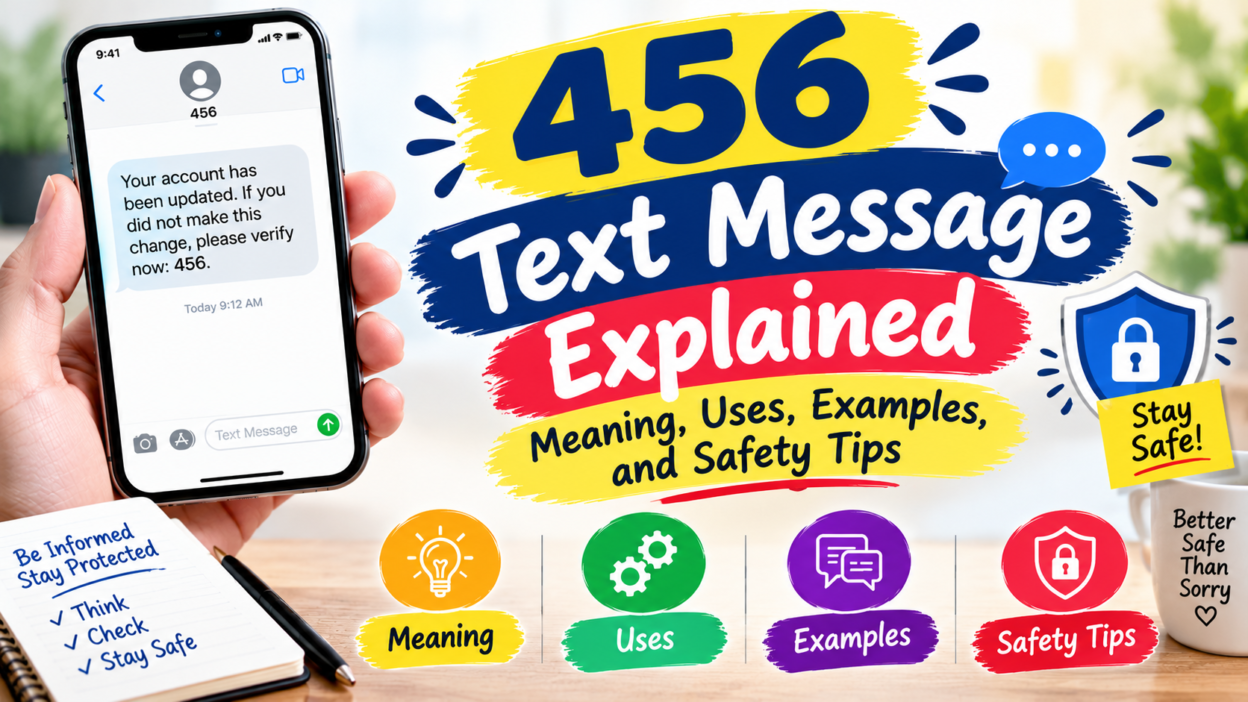
A 456 text message can be confusing when it appears unexpectedly on your phone. You might see 456 as the sender ID in your SMS inbox or notice the number inside a message. Naturally, you may wonder who sent it, why you received it, and whether it is safe to open or reply to.
The meaning of 456 depends on the context. In the United States, T-Mobile officially identifies 456 as a T-Mobile Alerts code. However, the same number may appear in other contexts, including personal conversations, numerical slang, or reference codes. Therefore, you should not assume that every message involving 456 comes from the same source.
Understanding the difference between a sender ID and a number written inside a message is the first step toward identifying its purpose. Additionally, checking your mobile carrier and reading the complete message can help you avoid unnecessary confusion.
In this guide, you’ll learn what a 456 text message may mean, how T-Mobile uses the code, how to recognize suspicious messages, and what steps to take if you receive an unexpected notification.
📱 What Does 456 Mean in a Text Message?
The meaning of 456 depends on how the number appears on your phone. It may serve as a mobile messaging code, a number within a conversation, or part of a reference identifier.
For T-Mobile customers in the United States, 456 is associated with the carrier’s alert system. T-Mobile’s official support documentation also explains that messages sent to this code may receive an automated response indicating that the channel is not monitored. for information about its messaging services.
However, this explanation does not automatically apply to every mobile network or country. If you use another carrier, you should verify the number through that provider’s official support resources.
Here are the main possibilities to consider:
- Carrier alert: The number may be associated with a mobile operator’s messaging service.
- Numerical slang: Someone may use 456 as an expression in an informal conversation.
- Reference number: The digits may form part of an account reference, transaction identifier, or other code.
- Unknown message: The source may remain unclear until you examine the complete message and verify the sender.
The important point is that 456 does not have one universal meaning. Your carrier, location, and the message’s content all help determine the most likely explanation.
🔎 Why Did You Receive a Text From 456?
Receiving a message from an unfamiliar number doesn’t necessarily mean something is wrong. In many cases, a notification may relate to a service or activity you have recently used. Nevertheless, you should verify unexpected messages before taking action.
1. You may have received a carrier alert
If you use T-Mobile in the United States, the number may be associated with its alert system. The message’s wording can provide additional information about the notification.
For example, it might refer to a mobile service or direct you toward a customer support resource. However, don’t assume that a specific alert concerns billing, roaming, or account security unless the message actually says so.
2. Your account activity may explain the message
Consider whether you recently changed your mobile plan, contacted customer service, or requested a service update. Such activity may help explain why you received a notification.
Even so, a connection between recent activity and an unexpected message should be verified rather than assumed.
3. The number may appear in a personal conversation
If someone sends you the digits 456 within a chat, they may be using numerical slang or referring to something specific in your conversation.
In that situation, the number is part of the message content rather than necessarily being the sender’s identity.
4. The message could be suspicious
Unexpected messages can sometimes imitate familiar companies or attempt to persuade recipients to reveal sensitive information.
Be particularly careful if a text demands immediate payment, threatens account suspension, or asks you to share a password. Instead of following its instructions, verify the claim through the company’s official website or app.
💬 Does 456 Have a Meaning in Texting Slang?
Yes. In some Chinese numerical texting slang, 456 can mean “it’s me.” This interpretation is associated with the resemblance between the number’s pronunciation and a Chinese expression used to identify oneself.
However, this meaning depends on the language and conversational context. It is not a universal texting abbreviation.
For example, imagine that a friend sends you the digits 456 in an informal conversation. If you both understand this numerical expression, the message may be a playful way of identifying the sender.
By contrast, if 456 appears as the sender ID of an SMS notification, the slang interpretation may not be relevant.
Consider these differences:
Context
Possible interpretation
Personal conversation
Numerical slang or an inside reference
T-Mobile notification in the United States
A code associated with T-Mobile Alerts
Business message
A reference number or service identifier
Unexpected SMS
An unknown sender or notification requiring verification
Therefore, always consider where the number appears before deciding what it means.
🛡️ Is a 456 Text Message Legitimate or a Scam?
A 456 text message is not automatically legitimate or fraudulent. Although T-Mobile documents its use of 456 for alerts, that fact alone cannot verify every message displaying the number.
Scammers sometimes imitate familiar brands, create fake account warnings, or use urgent language to pressure people into acting without checking the facts.
The following signs can help you evaluate an unfamiliar message.
Message characteristic
What it may indicate
Clear information about a service you use
Potentially legitimate, but still worth verifying
A request that matches an action you recently initiated
May be expected
A demand for your password or one-time code
Serious warning sign
An unfamiliar payment link
Requires independent verification
Threats of immediate suspension or legal action
Common pressure tactic
A message that cannot be confirmed through official support
Requires further investigation
These indicators are useful, but none provides absolute proof on its own. A genuine message may arrive unexpectedly, while a fraudulent message may look convincing.
How to recognize a suspicious message
Be cautious if the sender claims your mobile account will be closed unless you pay immediately. Similarly, treat unexpected prize offers and requests for personal information with suspicion.
Don’t click a link simply because the message mentions your carrier. Instead, open the official app or type the company’s known website address into your browser.
If the message claims to concern your T-Mobile account, contact the company through its official support channels.
Remember: The number 456 alone cannot establish whether a message is safe. You must consider the sender, the wording, and the circumstances in which it arrived.
📋 How to Check Who Sent the 456 Text Message
If you cannot identify the sender, follow these practical steps to investigate the message without exposing your personal information.
Step 1: Identify your mobile carrier
Check whether you use T-Mobile or another mobile provider. This information matters because short codes can serve different purposes across networks and countries.
If you live outside the United States, don’t assume that the T-Mobile explanation applies to your local carrier.
Step 2: Read the complete message
Look for a company name, service description, account reference, or explanation of why the message was sent.
A message that contains only a number may provide insufficient information to identify its source. In that case, you’ll need to investigate further.
Step 3: Review your recent activity
Think about whether you recently contacted customer support, changed your mobile service, or requested an account update.
This information may help you understand the notification. However, it should serve as a clue rather than proof of the sender’s identity.
Step 4: Verify the message independently
Open your mobile carrier’s official app or website. You can also contact customer support using a phone number obtained from the company’s verified website.
Avoid relying on links or contact details included in a suspicious message.
Step 5: Check your account for unusual activity
If the message mentions an account problem, review the relevant account for unfamiliar changes or unexpected charges.
If you notice anything unusual, contact the service provider promptly and follow its recommended security steps.
Step 6: Save the message if necessary
If you believe the message is fraudulent, keep a screenshot or record its wording and arrival time. This information may help your carrier investigate the incident.
Nevertheless, avoid sharing screenshots that expose passwords, verification codes, account numbers, or other sensitive details.
📲 Can You Reply to or Block Messages From 456?
Whether you should reply depends on the source and purpose of the message.
T-Mobile’s documentation indicates that sending a message to 456 may produce an automated response explaining that the channel is not monitored. Consequently, replying may not connect you with a customer service representative.
If you need help with a T-Mobile notification, use the company’s official support resources instead.
Should you block 456?
Blocking may be appropriate if the message is unwanted or suspicious. However, first determine whether the number is associated with legitimate notifications you want to receive.
Blocking a carrier-related sender could prevent useful alerts from appearing in your inbox. Therefore, consider the potential consequences before blocking it.
If the message is clearly fraudulent, use your phone’s reporting feature where available and block the sender if appropriate.
On most smartphones, you can open the conversation, access the sender’s information or options menu, and look for the block or report feature. The exact steps depend on your device and operating system.
Keep in mind that blocking one sender does not necessarily stop messages from other numbers or resolve an underlying account issue.
🌎 Does the Meaning of 456 Change by Country or Phone?
Yes. The meaning of a messaging code can depend on the country, mobile operator, and context in which the number appears.
A code associated with one carrier should not automatically be treated as a universal identifier.
Here are some important distinctions:
- United States: T-Mobile documents 456 as a T-Mobile Alerts code.
- Other countries: Local carriers may use different messaging arrangements. The same number may have another purpose or may not be used by a particular provider.
- iPhone and Android: Both types of phones can display SMS messages from supported messaging services. The device itself does not establish who owns the sender code.
- Messaging apps: If someone types 456 into a conversation, the number may represent slang, a personal reference, or a simple sequence of digits.
If you live in Pakistan or another country outside the United States, contact your local mobile operator to confirm whether it uses 456. The American T-Mobile explanation may not apply to your network.
⚠️ Common Mistakes to Avoid When Receiving a 456 Message
Unfamiliar numbers can create confusion, especially when a message arrives without an explanation. Avoiding these mistakes can help you make a more informed decision.
Mistake 1: Assuming every message from 456 is a scam
T-Mobile documents 456 as a code associated with its alert system. Therefore, an unfamiliar number does not automatically indicate fraud.
Instead, examine the message and verify its source.
Mistake 2: Assuming every message is safe
The opposite assumption can also be dangerous. A familiar-looking sender does not guarantee that a particular message is genuine.
Always verify unexpected requests for payment, personal information, or account access.
Mistake 3: Treating 456 as a universal short code
Messaging systems differ across countries and carriers. An explanation that applies to T-Mobile may not explain a message received through another provider.
Check the relevant carrier’s documentation before drawing conclusions.
Mistake 4: Replying repeatedly to an automated sender
Some messaging channels are not monitored. In T-Mobile’s case, sending a message to 456 may produce an automated response directing customers toward another support resource.
Use an official customer service channel if you need assistance.
Mistake 5: Clicking links to identify the sender
A suspicious link may lead to a fraudulent website. Instead, open the company’s official app or website independently.
This simple precaution reduces the risk of exposing your information to a fake service.
Mistake 6: Sharing verification codes
One-time verification codes can protect your accounts. Never share an unexpected code with someone who contacts you, even if they claim to represent a mobile provider or support team.
💡 Examples of 456 Text Messages and How to Respond
The following examples are illustrative. They are not verified messages from T-Mobile or any other company.
Example 1: An unexpected service notification
Message: “Your mobile service has an update. Check your carrier account for details.”
What it might mean: The message claims to concern a mobile service update.
What you should do: Open your carrier’s official app and check whether the notification matches an actual update. Don’t rely solely on a link included in the message.
Example 2: A suspicious payment demand
Message: “Your account will be closed in 10 minutes. Pay immediately using this link.”
What it might mean: The message uses urgency to pressure you into paying. This is a warning sign, although the wording alone cannot conclusively establish who sent it.
What you should do: Don’t click the link or enter payment details. Contact the provider through its official website or app to verify the claim.
Example 3: A personal conversation
Message: “456”
What it might mean: The sender may be using numerical slang or referring to something understood within your conversation. In some Chinese numerical texting contexts, 456 can mean “it’s me.”
What you should do: Consider the language and context of the conversation. If the meaning remains unclear, ask the sender through a trusted communication channel.
These examples show why the surrounding context matters. A carrier notification, a payment demand, and a personal message require different responses.
❓ Frequently Asked Questions About 456 Text Messages
1. What is a 456 text message?
A 456 text message may be associated with a mobile carrier’s alert system. In the United States, T-Mobile documents 456 as a T-Mobile Alerts code. However, the exact meaning depends on the carrier, message content, and location.
2. Is 456 an official T-Mobile code?
Yes. T-Mobile’s official support documentation identifies 456 as a code associated with its alerts. However, this does not automatically verify every message that displays the number. Always check the message’s content and verify unexpected claims.
3. Is a text message from 456 dangerous?
Not necessarily. The number’s association with T-Mobile alerts does not prove that every message is genuine or safe. Be cautious with suspicious links, unexpected payment requests, and demands for sensitive information.
4. Why did I receive a message from 456 if I didn’t request one?
You may have received a service-related notification or another alert. However, the exact reason cannot be determined from the number alone. Check your carrier’s official resources or contact customer support for clarification.
5. Can I reply to 456?
T-Mobile indicates that messages sent to 456 may receive an automated response explaining that the channel is not monitored. Therefore, use the company’s official support channels if you need help with a notification.
6. Does 456 mean “it’s me” in texting?
In some Chinese numerical texting slang, 456 can mean “it’s me.” However, that interpretation depends on the conversation’s language and context. It does not automatically explain an SMS received from a carrier’s sender ID.
7. Should I block 456 on my iPhone or Android phone?
First, check whether the messages are legitimate and whether you want to receive related notifications. If a message is suspicious or unwanted, you can use your phone’s blocking and reporting features. Keep in mind that blocking the sender may prevent useful alerts.
8. What should I do if a 456 message asks for my password or verification code?
Do not share your password or verification code. Avoid clicking suspicious links, and open the relevant service’s official app or website independently. If you have already disclosed sensitive information, contact the service promptly and take steps to secure your account.
✅ Conclusion
A 456 text message can have different meanings depending on where the number appears and which mobile carrier you use. In the United States, T-Mobile officially identifies 456 as a code associated with its alert system. In other contexts, the number may represent numerical slang, a reference identifier, or something else entirely. Therefore, read the complete message, consider your recent activity, and verify important claims through official support channels. Avoid unfamiliar links and never share passwords or verification codes in response to unexpected messages. By following these precautions, you can investigate a 456 notification calmly, protect your personal information, and decide what to do next.