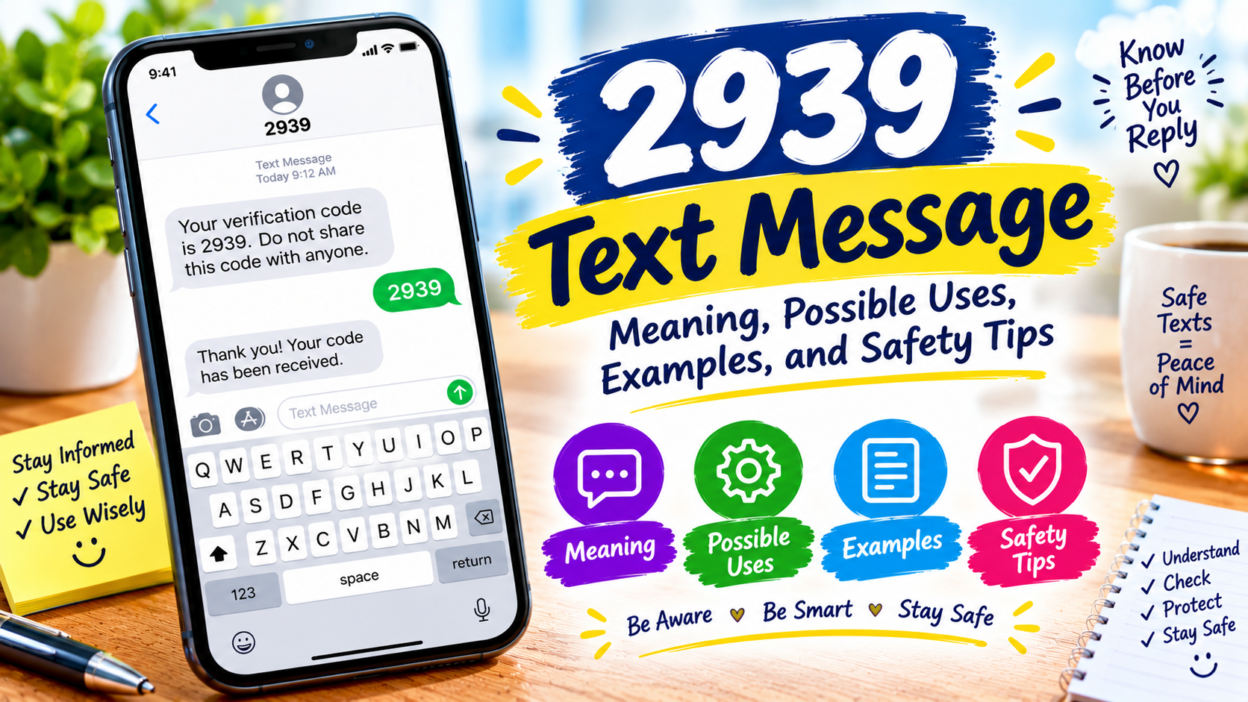
Receiving a message from an unfamiliar number can leave you wondering who sent it and why. If you’ve received a 2939 text message, you may want to know whether it’s a legitimate notification, a verification message, a business alert, or something you should ignore.
The important thing to understand is that 2939 alone doesn’t establish who sent the message or what it means. A four-digit number may serve as a short code in some messaging systems, but its purpose depends on the country, mobile carrier, organization, and message content. It could also appear as part of a longer number or reference code.
This guide explains how to investigate a message associated with 2939, recognize possible warning signs, and decide what to do next. You’ll also learn how to verify a sender, protect personal information, and avoid common mistakes when responding to unfamiliar texts.
Because the meaning of a short code can vary, the safest approach is to examine the complete message rather than assume that every text associated with the same number has an identical purpose.
📱 What Is the 2939 Text Message?
A 2939 text message is a text associated with the four-digit number 2939. However, the number alone doesn’t provide enough information to identify a specific company, service, or purpose reliably.
Short codes are commonly used by organizations and messaging platforms to send automated notifications, promotional messages, alerts, and verification codes. Nevertheless, not every four-digit number has the same meaning across different countries and networks.
For example, a message might contain a login verification code, a delivery update, a promotional offer, or a request to confirm an account detail. These are general examples of short-code messaging, not verified uses of 2939 specifically.
The actual message provides important clues. Look for the organization’s name, the reason for contacting you, any links, and whether the message matches something you recently did.
If you weren’t expecting the text, don’t assume it’s legitimate simply because it uses a short number.
🔎 Who Sends Text Messages From 2939?
Identifying the sender requires more than looking at the digits. Public reporting provides some clues, but it doesn’t establish a universal owner for this number.
For example, a public Truecaller community listing for 2939 shows user-submitted reports associated with Ecuador. Such reports can help with preliminary research, but they don’t independently verify the sender’s identity or prove that every message from 2939 originates from the same organization.
Truecaller
A separate online discussion associates 2939 with mobile network services, but that claim isn’t enough to establish an official ownership or purpose.
Mobile Services Center
Therefore, avoid relying on an unverified website to decide whether a message is safe.
Here are the most useful clues to examine:
- Country and carrier: A messaging number can have different meanings in different telecommunications systems.
- Message content: The wording may identify a company, service, or reason for contacting you.
- Recent activity: A message may relate to a sign-in, transaction, subscription, or service request you initiated.
- Official documentation: A company’s own support page or your carrier’s verified help channel can provide stronger evidence.
- Account history: Check whether the relevant service shows the same notification in its official app or account.
If these details don’t establish the sender’s identity, treat the message as unverified.
💬 Common Reasons You Might Receive a 2939 Text
There isn’t enough verified information to assign one specific purpose to every 2939 text. However, understanding common SMS categories can help you interpret the message without jumping to conclusions.
1. Account verification
Some services send one-time passwords or confirmation codes by SMS. If you recently attempted to sign in, check the official service directly. An unexpected code could mean someone entered your phone number by mistake or attempted to access an account.
2. Mobile network notifications
Carriers and messaging providers can use short numbers for service notifications. Nevertheless, don’t assume that 2939 belongs to your carrier without confirmation from its official support team.
3. Transaction or delivery updates
Businesses sometimes send order confirmations, payment alerts, and delivery notifications through automated messaging systems. Compare the text with your actual order or transaction history before acting.
4. Promotional or subscription messages
Some short codes support marketing campaigns, service announcements, and subscription communications. If you don’t recognize the sender, verify the service before replying or following instructions.
These are possible categories of text messaging, not confirmed uses of 2939. The exact wording and verified sender information remain essential.
🛡️ Is the 2939 Text Message Legitimate or a Scam?
A text from 2939 isn’t automatically legitimate or fraudulent. Its appearance alone cannot establish whether the message is safe.
- Legitimate organizations may use automated messaging systems. At the same time, scammers can imitate familiar brands, create urgent messages, and direct recipients to fraudulent websites.
- The safest approach is to evaluate the message’s behavior rather than judge it solely by its sender number.
- Message characteristic
- What it may indicate
- Recommended action
- Expected confirmation after an action you initiated
- A potentially legitimate notification
- Verify it in the official service
- Unexpected verification code
- A mistake or an attempted sign-in
- Don’t share the code; review account activity
- Urgent demand for payment
- Possible fraud or an account issue
- Check your account independently
- Link requesting passwords or banking details
- A potential phishing attempt
- Don’t open the link
- Request for a PIN or one-time password
- A serious warning sign
- Never disclose the code to an unsolicited contact
- Repeated unwanted promotional texts
- Possible unwanted messaging
- Use verified reporting or opt-out procedures
For additional protection, remember that a familiar-looking sender doesn’t prove that a message is genuine. Verify important requests through a trusted channel before sharing information or sending money.
🚩 Warning Signs to Watch for in a 2939 Text
Some suspicious messages are easy to recognize, while others imitate normal business communication. Pay particular attention to the following warning signs.
Unexpected urgency: A message claims that your account will close immediately unless you act. Fraudsters often use pressure to discourage careful checking.
Unusual links: The text directs you to an unfamiliar website or a shortened URL. Instead of opening it, visit the company’s official website independently.
Requests for confidential information: A sender asks for your password, banking PIN, recovery phrase, or one-time verification code. Don’t disclose these details in response to an unsolicited text.
Unfamiliar charges: The message claims that you’ve made a payment you don’t recognize. Check your bank or payment provider’s official transaction history rather than using the supplied link.
Unexpected rewards: A message promises a prize, refund, or gift but asks for an upfront payment or sensitive information. Verify the offer independently before proceeding.
Poorly explained instructions: The sender gives vague details but insists that you respond immediately. A legitimate notification should be verifiable through the organization responsible for it.
Importantly, spelling mistakes aren’t required for a scam to be convincing. A polished message can still be fraudulent, so evaluate the requested action and verify the sender.
📲 What Should You Do After Receiving a 2939 Text?
Your next step depends on what the message says and whether you expected it. Follow this practical process before responding.
- Read the complete message. Identify the claimed sender, the stated reason for contact, and any requested action.
- Think about recent activity. Did you recently sign in, place an order, request a code, or contact a mobile provider?
- Verify the organization independently. Open its official app, type its known website address yourself, or use a verified customer support number.
- Avoid suspicious links and attachments. Don’t download files or enter credentials on a website reached through an unexpected message.
- Protect private information. Never share passwords, banking PINs, or one-time codes with someone who contacts you unexpectedly.
- Report or block suspicious messages. Use your messaging app’s reporting features or your carrier’s official reporting process.
If the message appears to concern a real account problem, resolve it through the account provider directly. You don’t need to interact with an unverified sender to investigate a claim.
🔐 What If the Message Contains a Verification Code?
A verification code is a temporary number or combination of characters that a service may use to confirm an account action. It is different from the number that delivers the message.
For example, a message might say:
Illustrative example — not a verified 2939 message
Your sign-in verification code is 482716. Enter it in the app to continue.
If you requested the code, enter it only in the official app or website where you initiated the action.
However, if you didn’t request it, don’t panic. Someone may have entered the wrong phone number, or someone may be attempting to sign in using your details.
Take these precautions:
- Don’t share the code with anyone, even if they claim to be customer support.
- Don’t reply to an unexpected request to forward the code.
- Review your account’s recent activity if you suspect an unauthorized sign-in.
- Change your password through the official service if you discover suspicious activity.
- Enable stronger authentication options when available.
Receiving an unexpected code doesn’t automatically mean that your account has been compromised. Still, it deserves attention if you receive repeated codes or notice unfamiliar activity.
🌐 Does the Meaning of 2939 Change by Country or Mobile Carrier?
Yes, messaging numbers and short-code systems can vary across telecommunications markets. A number used for a particular service in one region may not have the same role elsewhere.
- For instance, Twilio explains that SMS short codes can contain between three and seven digits, and businesses use them for purposes such as marketing, notifications, and two-factor authentication.
- In the United States, however, common business short codes generally use five or six digits. Consequently, a four-digit number like 2939 shouldn’t automatically be treated as a standard US business short code.
- untrappable
- In other countries, local operators may support different numbering arrangements. The sender may also appear differently depending on the network or messaging provider.
- Consider these distinctions:
- Factor
- Why it matters
- Country
- Local numbering rules and messaging systems differ
- Mobile carrier
- Operators may support their own service codes
- Message type
- A marketing text differs from a security alert
- Sender identification
- A number alone may not identify the underlying organization
- Message content
- The wording may help establish the intended purpose
Therefore, check the country and carrier associated with your actual message before relying on information from a website covering another region.
🧩 How to Identify the Sender More Reliably
When a number doesn’t have a clearly documented owner, use several independent clues rather than relying on a single lookup result.
Start with the message itself. Look for a company name, service description, reference number, or recognizable transaction.
Check official support information. Search the organization’s own website for its messaging policies, notification numbers, or customer support instructions.
Review your account independently. If the message mentions a purchase, subscription, payment, or sign-in, check the corresponding account directly.
Ask your mobile carrier. If you suspect the number belongs to a network service, contact your carrier through its official support channel. Explain when the message arrived and what it contained.
Use third-party lookup services cautiously. Community reports can suggest a possible sender, but users may submit incorrect, outdated, or incomplete information. A listing is a lead, not proof.
These steps are especially useful when a search engine returns conflicting explanations for the same number.
⚠️ Common Mistakes to Avoid When Investigating 2939
A few common mistakes can make an unfamiliar message harder to evaluate. Avoid these assumptions when deciding what to do.
Assuming a short number is automatically safe. Short numbers can support legitimate messaging, but the number alone doesn’t authenticate the content.
Treating every unexpected text as a confirmed scam. An unexpected notification may result from a typing error, a delayed message, or an account action you don’t remember. Investigate without following suspicious instructions.
Trusting search results without checking the source. Third-party directories sometimes repeat unverified claims. Prefer official documentation and direct confirmation from the relevant organization.
Replying immediately to an unknown sender. A response may confirm that your number is active or expose you to further unwanted contact. Verify the sender before replying.
Ignoring repeated verification codes. One unexpected code may be harmless, but repeated codes could indicate attempted account access. Review your account security if the pattern continues.
Sharing screenshots without removing private details. A screenshot can expose verification codes, phone numbers, account identifiers, or other sensitive information. Redact these details before sharing a message for help.
The best strategy is simple: verify first, protect your information, and respond only when you understand who is contacting you.
🧰 How to Block or Report an Unwanted 2939 Message
If the message is unwanted, suspicious, or repetitive, you can take steps to reduce further contact.
On most smartphones, you can open the conversation, access its details, and select the available block or report option. The exact instructions depend on your device and messaging app.
If the text appears to be legitimate marketing, check the organization’s official opt-out instructions. Some recognized messaging programs support keywords such as STOP, but don’t assume that replying is appropriate for every unknown sender.
For a suspicious message:
- Don’t click links or download attachments.
- Keep a screenshot if you need evidence, after securing any sensitive information.
- Use your messaging app’s spam-reporting option when available.
- Contact your mobile carrier for its reporting procedure.
- If you disclosed banking information, contact your bank through an official channel immediately.
- If you shared an account password, change it through the legitimate service and review recent activity.
Reporting options vary by country and carrier. For example, don’t assume that a reporting number available in one country works on another network.
If a message involves suspected financial fraud, prioritize protecting your account rather than engaging with the sender.
💡 Practical Tips for Safer Text Messaging
Good messaging habits can help you avoid problems with unfamiliar numbers, not just 2939.
First, keep your phone’s operating system and messaging applications updated. Updates can improve security and help address known vulnerabilities.
Next, use unique passwords for important accounts and enable multifactor authentication where practical. A password manager can help you manage those passwords safely.
Additionally, review account notifications regularly. If you receive an alert you don’t recognize, compare it with your account’s actual activity instead of trusting the message alone.
Be especially careful with requests involving money, identity documents, account recovery, or urgent security changes. When something seems unusual, contact the organization through a channel you already trust.
Finally, remember that you don’t have to respond immediately. Taking a moment to verify a message is often safer than acting under pressure.
❓ Frequently Asked Questions About the 2939 Text Message
1. What does the 2939 text message mean?
The meaning depends on the country, carrier, messaging system, and message content. There isn’t enough verified evidence to assign one universal purpose to 2939. Check the complete message and confirm the sender through an official source.
2. Who owns the number 2939?
The available information doesn’t establish a universally verified owner. Some public listings contain community reports, but those reports don’t prove ownership. Your mobile carrier or the organization mentioned in the message may be able to clarify its origin.
3. Is a text from 2939 a scam?
Not necessarily. An unfamiliar number alone doesn’t prove fraud. However, requests for passwords, verification codes, unusual payments, or sensitive personal information deserve caution. Verify the sender independently before taking action.
4. Should I reply to a message from 2939?
Only consider replying after verifying the sender and understanding the purpose of the message. If it looks suspicious, avoid responding and use your messaging app’s reporting options. Follow opt-out instructions only when you can establish that they belong to a legitimate messaging program.
5. What should I do if I receive a 2939 verification code I didn’t request?
Don’t share the code with anyone. Someone may have entered your number accidentally, or someone may be attempting to access an account. Check the relevant account through its official app or website, and review recent activity if you notice anything unusual.
6. Can 2939 be associated with different services in different countries?
Yes, numbering arrangements and messaging practices differ between countries and mobile networks. However, this doesn’t confirm that 2939 belongs to any particular service. Check the sender against documentation relevant to your own country and carrier.
7. Will blocking 2939 stop all unwanted text messages?
Blocking a sender can reduce messages from that specific number or sender identity. However, it may not prevent messages arriving through other numbers or sender IDs. If unwanted texts continue, report them through your messaging app or carrier.
8. How can I confirm whether a 2939 message is genuine?
Check the message content, review any related account activity, and contact the organization through its official app, website, or verified support channel. Don’t use an unfamiliar link or telephone number supplied in a suspicious message as your only means of verification.
✅ Final Thoughts on the 2939 Text Message
A 2939 text message can be confusing when the sender and purpose aren’t immediately clear. However, you don’t need to guess what it means or assume that it’s dangerous. Examine the message, consider your recent activity, and verify the claimed sender through a trusted source. If it contains an unexpected verification code, protect it. If it requests sensitive information or urges you to open a suspicious link, don’t follow those instructions. Most importantly, remember that the number alone cannot establish authenticity. Careful verification and sensible security habits will help you decide whether to respond, report, block, or simply ignore the message.