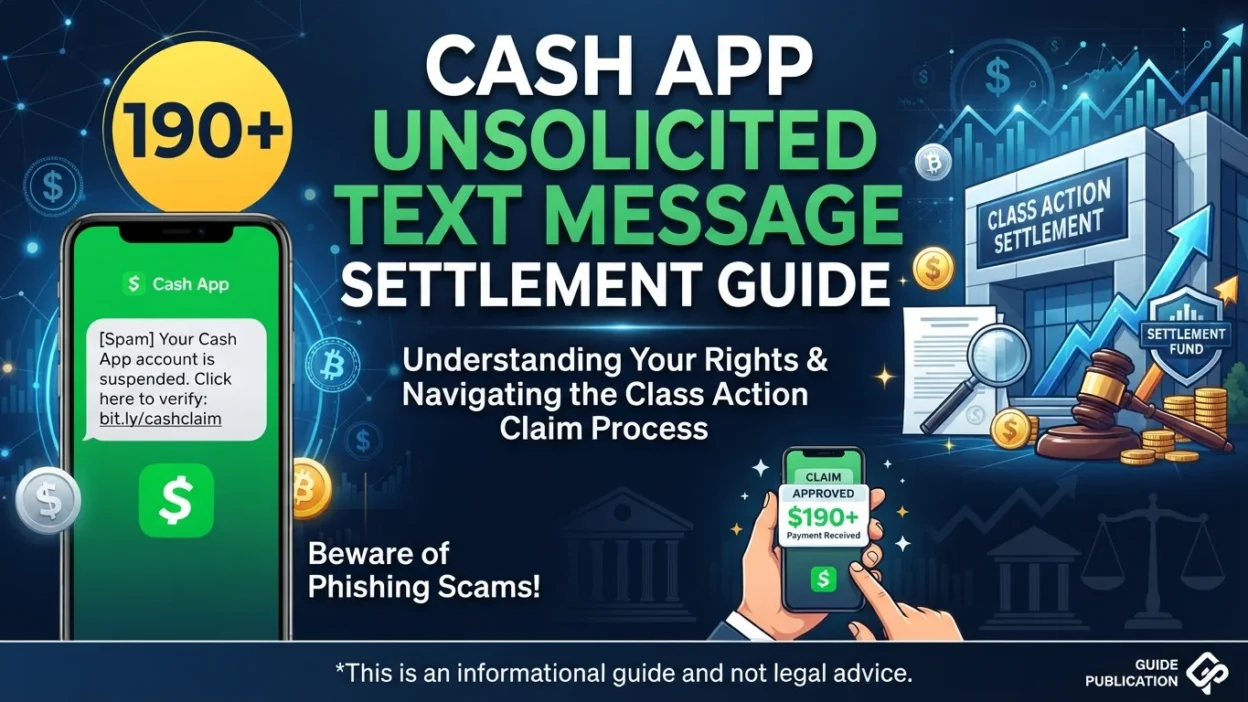
If you’ve searched for the cash app unsolicited text message settlement, you’re probably wondering whether the message you received is real or just another scam. That uncertainty can feel frustrating, especially when text scams have become so common. Fortunately, understanding how legitimate settlements work can help you protect both your money and your personal information.
Sometimes, we all feel uncertain when an unexpected text appears on our phone. A message may promise compensation, mention a legal settlement, or ask you to click a link immediately. However, taking a few minutes to verify the information can save you from costly mistakes. This guide explains everything you should know about the cash app unsolicited text message settlement, including eligibility, warning signs, and how to stay safe.
What Is the Cash App Unsolicited Text Message Settlement?
The cash app unsolicited text message settlement generally refers to a legal settlement involving allegations that promotional or automated text messages were sent without proper consent. These cases are typically filed under consumer protection laws designed to prevent unwanted marketing communications.
It’s important to understand that a settlement does not automatically mean the company admitted wrongdoing. Instead, many companies choose to resolve lawsuits through settlements to avoid lengthy court proceedings.
As a result, eligible users may receive compensation if they meet the settlement requirements.
Why Do These Settlements Happen?
Companies communicate with customers through email, phone calls, push notifications, and text messages. However, businesses must follow laws that regulate electronic communications.
Common reasons lawsuits arise include:
- 📱 Sending promotional texts without proper consent
- 📱 Sending automated messages after users opted out
- 📱 Contacting recycled phone numbers
- 📱 Continuing marketing campaigns despite unsubscribe requests
- 📱 Violating federal or state consumer protection laws
Because consumer privacy has become increasingly important, courts carefully review these claims before settlements are approved.
Understanding Unsolicited Text Messages
An unsolicited text message is any message you receive that you did not request or authorize.
Examples include:
- Promotional offers
- Sweepstakes notifications
- Loan advertisements
- Investment opportunities
- Fake banking alerts
- Delivery scams
- Cryptocurrency promotions
- Payment app notifications you weren’t expecting
Although some messages are legitimate marketing communications, others are designed to steal personal information.
Therefore, it’s essential to verify every unexpected message before taking action.
Who May Qualify for the Settlement?
Eligibility depends on the specific settlement agreement.
Generally, you may qualify if you:
- ✅ Received qualifying text messages during the covered period
- ✅ Meet the legal class definition
- ✅ Did not previously exclude yourself from the settlement
- ✅ Submit a valid claim before the deadline, when required
Every settlement has different eligibility rules. Consequently, reading the official settlement notice is always the best approach.
How Legitimate Settlement Notices Usually Work
Many people assume every unexpected settlement message is fake. Fortunately, legitimate settlements follow a structured legal process.
Typically, the process includes:
- A lawsuit is filed.
- The parties negotiate a settlement.
- A judge reviews the agreement.
- Eligible class members receive official notice.
- Claims are submitted, if required.
- The court grants final approval.
- Payments are distributed according to the settlement terms.
Because this process involves court oversight, official notices usually contain detailed information rather than urgent demands.
Warning Signs of Fake Settlement Texts 🚨
Scammers often exploit well-known brands.
Watch for these red flags:
- 🚩 Requests for your Cash App PIN
- 🚩 Demands for immediate payment
- 🚩 Messages claiming you’ve “won” money unexpectedly
- 🚩 Links with unusual website addresses
- 🚩 Poor grammar and spelling
- 🚩 Threats that your account will be suspended
- 🚩 Requests for Social Security numbers
- 🚩 Requests for banking passwords
A legitimate settlement administrator will never ask for sensitive credentials through text messages.
How to Verify a Settlement Safely
Instead of clicking links immediately, take these steps:
Visit Official Sources
Search for the settlement name through trusted legal resources or official court documents.
Read the Settlement Notice
A legitimate notice explains:
- Eligibility
- Deadlines
- Court information
- Administrator contact details
- Claim instructions
Verify Website Security
Official settlement websites generally use secure HTTPS connections and provide detailed legal documentation.
Contact Customer Support
If you’re unsure, contact Cash App through its official support channels instead of replying to the text.
Common Questions People Ask
Many users wonder:
- Is the settlement real?
- Am I eligible?
- How much money will I receive?
- When are payments sent?
- Do I need to submit proof?
- What if I deleted the text?
- Can scammers impersonate settlement administrators?
These are valid concerns. Fortunately, each official settlement provides answers tailored to that specific case.
Protecting Yourself from Text Message Scams
Receiving an unexpected message can create excitement or anxiety. Nevertheless, staying cautious is the best defense.
Good habits include:
- 🔒 Never share verification codes.
- 🔒 Ignore suspicious links.
- 🔒 Enable two-factor authentication.
- 🔒 Monitor your accounts regularly.
- 🔒 Report spam messages.
- 🔒 Update your passwords periodically.
- 🔒 Verify before responding.
These simple precautions significantly reduce your risk of fraud.
Why Consumer Privacy Laws Matter
Consumer protection laws exist to give individuals greater control over how companies communicate with them.
Without these protections:
- Businesses could send unlimited automated messages.
- Consumers would have fewer privacy rights.
- Scam activity would become even more difficult to combat.
Therefore, settlements involving unsolicited communications also reinforce broader consumer privacy standards.
What to Do If You Already Clicked a Suspicious Link
Don’t panic. Instead, act quickly.
You should:
- Disconnect from suspicious websites.
- Change your passwords immediately.
- Enable multi-factor authentication.
- Monitor your financial accounts.
- Report the incident to the appropriate platform and your mobile carrier if necessary.
- Watch for unusual account activity over the following weeks.
Acting promptly can help reduce potential risks.
Understanding Claims, Payments, and Your Rights
Now that you understand what the cash app unsolicited text message settlement is and how to recognize legitimate notices, the next step is learning how claims work. Many people miss compensation simply because they assume they’re automatically enrolled or because they ignore an official notice.
Fortunately, the process is usually straightforward when you follow the instructions carefully.
How Settlement Claims Usually Work
Every class-action settlement follows its own rules. However, most claim processes are similar.
A typical process looks like this:
- 📄 You receive an official settlement notice.
- ✅ You review the eligibility requirements.
- 📝 You complete a claim form if required.
- 📅 You submit it before the deadline.
- ⚖️ The court gives final approval.
- 💵 Payments are distributed to approved claimants.
Sometimes no action is required because eligible people receive payments automatically. In other cases, filing a claim is necessary.
What Information May Be Required?
A legitimate claim form generally requests only information needed to verify your eligibility.
Depending on the settlement, you may need to provide:
- Your full name
- Your mailing address
- Your email address
- The phone number that received the qualifying text messages
- A claim identification number (if provided)
- A signed certification confirming the information is accurate
However, legitimate settlement administrators typically do not ask for your Cash App PIN, password, verification code, or banking password.
How Much Money Could You Receive?
This is often the first question people ask after hearing about a cash app unsolicited text message settlement.
The honest answer is that there is no guaranteed payment amount.
Your payment may depend on factors such as:
- The total settlement fund
- The number of approved claims
- Court-approved legal fees
- Administrative costs
- Whether the settlement offers fixed or proportional payments
Therefore, estimates shared on social media should be viewed with caution unless they come from official settlement documents.
Why Payment Amounts Vary
Many people are surprised when payments differ from online rumors.
Several factors affect compensation, including:
- Total eligible participants
- Valid claims submitted
- Court-approved expenses
- Settlement agreement terms
As a result, two different settlements involving similar allegations may produce very different payment amounts.
How Long Do Settlement Payments Take?
Patience is important.
Even after a settlement receives preliminary approval, several additional steps usually occur before payments are issued.
The timeline may include:
- Notice period
- Claim submission deadline
- Objection period
- Final court hearing
- Processing of approved claims
- Distribution of payments
Consequently, payments may take several months after final approval.
Payment Methods You May See
Settlement administrators often provide multiple payment options.
These may include:
- 💳 Direct deposit
- 📱 Digital payment platforms
- 📬 Paper checks
- 💰 Prepaid debit cards
- 🏦 ACH bank transfers
Available methods depend on the specific settlement agreement.
Can You File More Than One Claim?
Generally, each eligible person may submit only one valid claim for the same qualifying phone number or account, unless the settlement specifically states otherwise.
Submitting duplicate claims may delay processing or result in denial.
Therefore, always read the settlement instructions before submitting additional forms.
What Happens If You Miss the Deadline?
Unfortunately, deadlines are one of the most important parts of any settlement.
If you submit your claim after the deadline:
- Your claim may be rejected.
- You may lose the opportunity to receive compensation.
- Exceptions are rarely granted.
Because of this, it’s wise to complete your claim as soon as you confirm you’re eligible.
Real-Life Example
Imagine Sarah receives a text mentioning a legal settlement involving promotional messages.
At first, she assumes it’s another scam and ignores it.
A few days later, she decides to verify the information instead of clicking the text link. She searches for the settlement through official legal sources, confirms that it is legitimate, and discovers she qualifies. After submitting her claim before the deadline, she simply waits for the court process to finish.
Meanwhile, her friend receives a similar-looking message from an unknown sender promising “instant settlement money.” The website asks for his Cash App PIN and verification code. Because he recognizes the warning signs, he deletes the message immediately.
These two situations highlight why verification matters more than acting quickly.
Common Mistakes to Avoid 🚫
Many settlement claims are delayed because of avoidable errors.
Here are some of the most common mistakes:
- ❌ Ignoring official notices
- ❌ Missing filing deadlines
- ❌ Entering the wrong phone number
- ❌ Providing outdated contact information
- ❌ Submitting duplicate claims
- ❌ Clicking suspicious links from unknown senders
- ❌ Sharing sensitive account credentials
Taking a few extra minutes to review your information can prevent unnecessary problems.
Tips for Protecting Your Cash App Account
Whether or not you’re eligible for a settlement, protecting your account should always be a priority.
Consider these best practices:
- 🔐 Use a strong, unique password.
- 📲 Enable two-factor authentication if available.
- 🔄 Keep your app updated.
- 👀 Review account activity regularly.
- 🚫 Never send money to someone you don’t know.
- 📩 Be cautious of unexpected texts or emails.
- 📞 Contact official support if something seems unusual.
These habits can help reduce the risk of fraud and unauthorized access.
Know Your Consumer Rights
Consumer protection laws exist to help individuals maintain control over their personal information and communications.
As a consumer, you generally have the right to:
- Receive truthful marketing communications.
- Opt out of many promotional text messages.
- Report unwanted or deceptive messages.
- Seek remedies when laws have been violated.
- Review official settlement notices and decide whether to participate.
Understanding these rights empowers you to make informed decisions rather than reacting to unexpected messages.
Frequently Asked Questions About Cash App Unsolicited Text Message Settlement
1. Is the Cash App unsolicited text message settlement legitimate?
It depends on the specific notice you receive. Some settlement notices are legitimate and are sent by court-approved settlement administrators. However, scammers often imitate these notices. Always verify the information through the official settlement website or court documents before clicking any links or sharing personal information.
2. How do I know if I qualify?
Eligibility depends on the settlement agreement. Generally, you must meet the class definition, which may include receiving qualifying text messages during a specific period. Review the official notice carefully to determine whether you qualify.
3. Do I need to submit a claim?
Some settlements require eligible individuals to submit a claim form, while others issue payments automatically. Read the official instructions to determine whether any action is required on your part.
4. Will I receive a large payment?
Not necessarily. Payment amounts vary based on the settlement fund, the number of approved claims, court-approved fees, and other factors. No one can guarantee a specific amount unless it is stated in the official settlement agreement.
5. Can scammers send fake settlement texts?
Yes. This is one of the most common tactics used by fraudsters. Be cautious if a message asks for your password, verification code, PIN, or immediate payment. Legitimate settlement administrators will not request sensitive financial credentials by text message.
6. What should I do if I accidentally clicked a suspicious link?
Act quickly but calmly.
- Change your passwords immediately.
- Enable multi-factor authentication where available.
- Monitor your accounts for unusual activity.
- Report suspicious messages to the appropriate service provider.
- Contact official customer support if you believe your account may have been compromised.
Prompt action can help reduce potential risks.
7. Can I opt out of future promotional text messages?
In many cases, yes. Businesses often provide instructions for opting out, such as replying with “STOP” to marketing messages. If unwanted texts continue after you’ve opted out, you may wish to report them through the appropriate consumer protection channels
These simple habits can protect both your personal information and your finances.
Conclusion
Receiving an unexpected message about a cash app unsolicited text message settlement can leave you feeling uncertain. While some notices are genuine and part of legitimate legal proceedings, others are designed to trick people into revealing sensitive information.
The safest approach is to pause before taking action. Verify the source, read the official settlement details, and never provide confidential account information through text messages. A few extra minutes of caution today can prevent significant financial and personal stress tomorrow.
Technology makes our lives more convenient, but it also requires us to stay informed. By understanding how legitimate settlements work and recognizing the warning signs of scams, you can make confident decisions and protect your privacy.
Whenever you receive an unexpected message, let curiosity be guided by caution. Staying informed is one of the best ways to safeguard your digital life.